
Percent or percentage points? Relative and absolute risk
Going from 2% to 3% is one percentage point but a 50% rise; learn to hear which one a headline is using and to ask for the real numbers.
Percentage point
The plain difference between two percentages, written "pt" or "points". A percent change, by contrast, is that difference as a share of where you started. Same two numbers, two different ways to describe the gap.
From 2% to 3%: 3 − 2 = 1 percentage point. As a share of the start, 1 is half of 2, so it's also a 50% increase.
Check yourself
A rate rises from 2% to 3%. Which description is correct?
- Up 1 percentage point, which is a 50% increase
- Up 1%, which is a 1 percentage point increase
- Up 50 percentage points
- Up 1.5 percentage points, since 3 is 1.5 times 2
Show the answer
Up 1 percentage point, which is a 50% increase
Right. The gap is 3 − 2 = 1 percentage point, and that 1 is half of the starting 2, so it's a 50% increase. Two true descriptions of one change.
Step through it
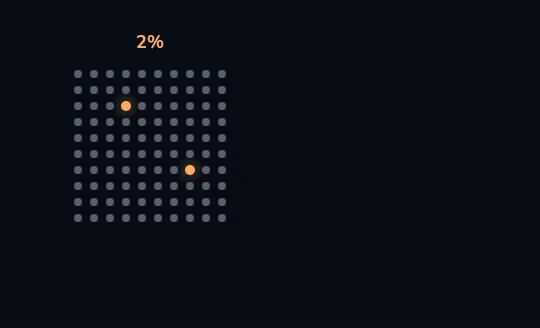
Before: 2 in every 100 A grid of 100 dots, one for each person, labelled 2%. Two of the dots are orange: before the change, 2 people in every 100 are affected. The rest, in grey, are not.
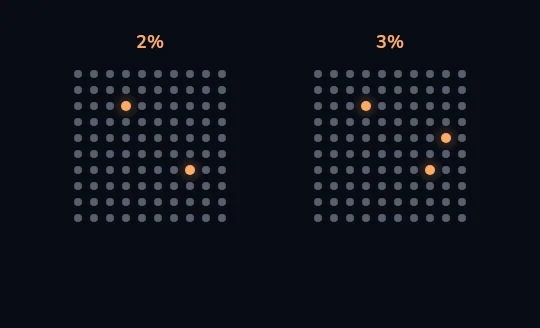
After: 3 in every 100 A second grid of 100 appears on the right, labelled 3%, with three orange dots. After the change, 3 people in every 100 are affected: one more person per hundred than before.
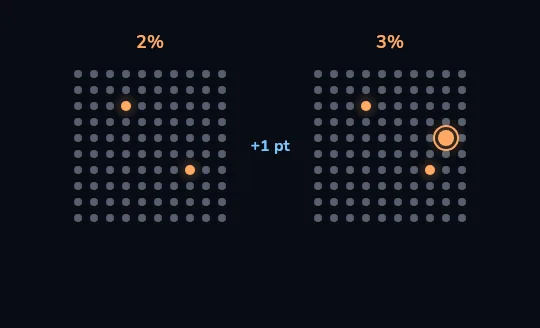
The gap: 1 percentage point The one extra orange dot on the right grid glows inside a ring, and the label +1 pt appears between the grids. The difference is 1 percentage point: 3 minus 2.
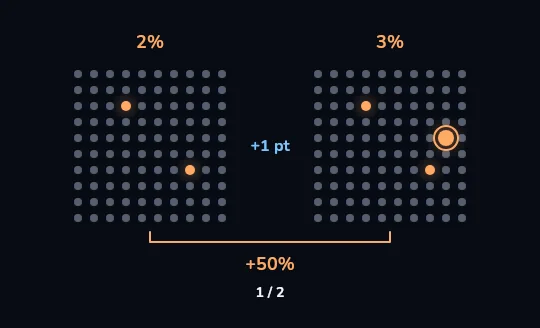
The same gap, told as +50% A bracket spans both grids with +50% in orange and 1 / 2 underneath: the one extra person, measured against the 2 you started with. The same change, told as a share of where it started, becomes "a 50% rise". Both are true. Only one sounds scary.
Check yourself
Saying "3% is 1% higher than 2%" is the correct way to describe the change.
Show the answer
False
False. 3% is 1 percentage point higher than 2%, and 50% higher in relative terms. "1% higher" would mean 2% × 1.01, which is 2.02%. The slip is common, even in news reports, and it's worth catching.
Relative risk and absolute risk
Relative: "doubles your risk"
Compares the new risk with the old one as a ratio or a percent change.
Sounds big whenever the starting number is small. It tells you nothing about how many people are affected.
Absolute: "1 more in 1,000"
Says how many people out of a group are affected, before and after.
The same doubling might be 1 in 1,000 → 2 in 1,000: one extra case per thousand, or +0.1 percentage points.
Check yourself
A headline says: "Snack X doubles your risk of disease Y." What's the first question to ask?
- Which company makes snack X?
- What was the risk to begin with, in real numbers?
- Is doubling bigger than a 50% rise?
- How many snacks does the average person eat?
Show the answer
What was the risk to begin with, in real numbers?
Right. "Doubles" is a relative change. Doubling 1 in 10 is a serious worry; doubling 1 in 100,000 barely matters. You need the starting risk to know which it is.
BENEFITS GET THE SAME TREATMENT
"Cuts deaths by 50%" can mean 1 in 100
Good news is inflated the same way. If a drug lowers the risk of dying from 2 in 100 to 1 in 100, it "halves the risk" (relative), and it also saves one person per hundred treated (absolute, 1 percentage point). Flip that around and 100 people take the drug for one of them to benefit. Doctors call this the number needed to treat. Neither version is a lie; you just need both to judge a treatment's side effects and cost against its benefit.
"Cuts deaths by 50%" and "1 fewer death for every 100 people treated" describe the same result. The second one lets you weigh it.
Check yourself
A drug cuts the risk of a heart attack from 2 in 100 to 1 in 100. Sort each statement.
- It cuts the risk by 50%
- It cuts the risk by 1 percentage point
- About 100 people take it for one to benefit
- Most people who take it avoid a heart attack because of it
- It cuts the risk by 50 percentage points
- It lowers the risk to 1%, so 99 in 100 people benefit
Show the answer
Correct: It cuts the risk by 50%, It cuts the risk by 1 percentage point, About 100 people take it for one to benefit
Wrong: Most people who take it avoid a heart attack because of it, It cuts the risk by 50 percentage points, It lowers the risk to 1%, so 99 in 100 people benefit
Percentages that trick the ear
- Interest rates
From 4% to 5% is "up 1 point" or "up 25%" (1 out of 4). Unemployment falling from 5% to 4% is "down 1 point" or "down 20%" (1 out of 5).
- Up then down doesn't cancel
A price of 100 rises 50% to 150, then falls 50% to 75. The second 50% is taken from a bigger number, so you end below where you started.
- A percentage of a small share
"30% more people chose X" sounds large, but if X had 5% of the market, it's now 6.5%: still small.
- Groups of different sizes
"20% of village A and 10% of city B" can mean 20 people against 10,000. Check what each percentage is out of before comparing.
Check yourself
A jacket costs 100. Its price rises 50%, then the new price falls 50%. What does it cost now?
- 100, because the changes cancel out
- 75
- 50
- 125
Show the answer
75
Right. 100 plus 50% is 150. Half of 150 is 75. The fall is taken from a bigger number than the rise, so the two don't cancel.
The habit to build
- When you see a relative change ("doubles", "cuts by 30%"), find the starting number.
- When you see only a percentage, ask what it is a percentage of.
- Say "points" for the gap between two percentages, and "percent" for a change relative to the start.
- For any risk or benefit, ask for the absolute version: how many out of 100, or 1,000?
Lesson recap
- A percentage point is the plain gap between two percentages; a percent change is that gap as a share of the start.
- From 2% to 3% is +1 percentage point and a 50% rise: both true, and one sounds far scarier.
- Relative risk ("doubles") hides how many people are affected; absolute risk (1 → 2 in 1,000) shows it.
- Benefits are inflated the same way: 2 in 100 → 1 in 100 is "50% fewer deaths" and one person helped per 100 treated.
- Percent changes don't cancel: 100 up 50% and down 50% ends at 75.