
Bid, ask and the spread
Learn why you buy at one price and sell at a lower one, what that gap costs you on every round trip, and when it gets wide.
TWO PRICES, NOT ONE
You buy at one price and sell at another
At any moment there are two prices, not one. If you want to buy right now, you have to pay what the cheapest seller asks: the ask, 100.10. If you want to sell right now, you get what the highest buyer bids: the bid, 99.90. The buy price is always the higher of the two, because each side trades with the other side's best offer.
A currency exchange booth works the same way. It shows a "we buy" rate and a "we sell" rate. Swap your money in and straight back out and you walk away with a bit less.
Spread
The gap between the best ask and the best bid: spread = ask − bid. With ask 100.10 and bid 99.90 the spread is 0.20. Halfway between them is the mid price, 100.00, which is what many charts plot. As a share of the mid, the spread is 0.20 ÷ 100.00 = 0.2%.
Ask 50.05, bid 50.00: spread 0.05, mid 50.025, about 0.1% of the price.
Check yourself
The bid is 99.90 and the ask is 100.10. What is the spread?
- 0.10
- 0.20
- 100.00
- 200.00
Show the answer
0.20
Right. Spread = ask − bid = 100.10 − 99.90 = 0.20.
buy 100 at the ask:   100 × 100.10 = 10,010
sell 100 at the bid:  100 ×  99.90 =  9,990

result: 9,990 − 10,010 = −20−20, and the price has not movedThis is the round-trip cost of the spread: in and straight back out. It is 0.20 per share times 100 shares. A trade has to move more than the spread in your favour just to get back to zero, and that is before any fees.
Check yourself
Leila buys 200 shares at the ask of 100.10 and sells them a minute later at the bid of 99.90. The quotes have not changed. What is her result?
- Zero, because the price didn't move
- A loss of 20
- A loss of 40
- A gain of 40
Show the answer
A loss of 40
Right. She loses the spread on every share: 0.20 × 200 = 40, even though nothing happened to the price.
WHO EARNS IT
Market makers are paid by the spread
Someone has to be willing to buy from you when you want to sell, and sell to you when you want to buy, at any moment. Firms called market makers or liquidity providers keep quoting both sides all day. They buy at the bid and sell at the ask, and the spread is what pays them for the risk of holding shares while prices move. That is also why many "zero-commission" apps are not free: part of what you pay is inside the spread. Lesson 10 adds up those costs.
A market maker buys 100 from one trader at 99.90 and sells 100 to another at 100.10 a moment later. If the price didn't move in between, it earned 20.
Busy market versus quiet market
Heavily traded
Price around 100, spread 0.01.
0.01 ÷ 100 = 0.01% of the price. The cost of getting in and out is tiny.
Thinly traded
Bid 9.50, ask 10.50, mid 10.00. Spread 1.00.
1.00 ÷ 10.00 = 10% of the price. You are 10% down the moment you buy.
Check yourself
Which spread costs more, as a share of the price?
- 0.20 on a price of 100
- 1.00 on a price of 10
- They cost the same
- It can't be compared without the number of shares
Show the answer
1.00 on a price of 10
Right. 0.20 on 100 is 0.2%, while 1.00 on 10 is 10%, fifty times more. Always compare spreads as a percentage.
When spreads get wide
- Around big news: market makers pull back until the dust settles, so quotes move apart.
- At the open and the close of the trading day, when orders pile up and prices are still being found.
- Outside main trading hours, when fewer people are quoting.
- In small, new or rarely traded assets, where few orders wait near the price.
- A spread you saw a minute ago is not a promise: check the live bid and ask at the moment you trade.
Check yourself
Would you expect the spread to be wide or tight?
- Seconds after a surprise announcement
- Midday, in a heavily traded share on a normal day
- Late at night, outside the main trading session
- A small asset listed last week
- A major currency pair during its busiest hours
- The first minute after the market opens
Show the answer
Likely wide: Seconds after a surprise announcement, Late at night, outside the main trading session, A small asset listed last week, The first minute after the market opens
Likely tight: Midday, in a heavily traded share on a normal day, A major currency pair during its busiest hours
Check yourself
Ignoring fees, if you just bought at the ask, your trade only shows a profit once the bid rises above the price you paid.
Show the answer
True
True. To cash out you sell at the bid. Right after buying at 100.10, the bid is 99.90, so the bid has to climb more than the whole 0.20 spread before selling would leave you ahead.
Step through it
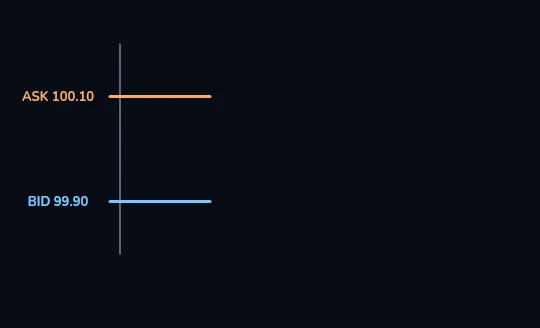
ASK 100.10 above, BID 99.90 below On a vertical price axis, an orange line marks the ask at 100.10 and a blue line below it marks the bid at 99.90. Right now a buyer pays 100.10 and a seller gets 99.90.
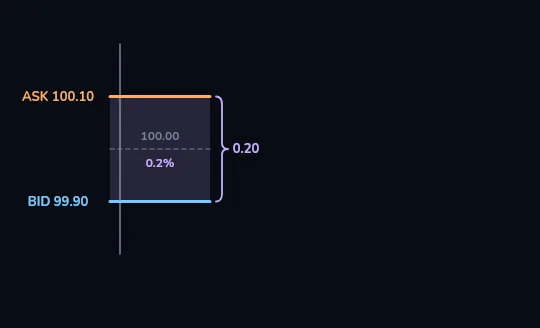
The gap is the spread: 0.20 The space between the two lines is shaded lilac and a brace beside it reads 0.20. A dashed line through the middle marks the mid price, 100.00, and the label 0.2% shows the spread as a share of that price.
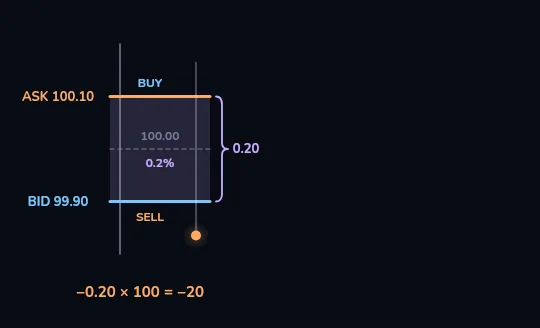
Buy at the ask, sell at the bid: −20 A dot comes in at the ask, marked BUY, and drops straight out below the bid, marked SELL. The readout underneath says −0.20 × 100 = −20. Buy 100 shares and sell them at once and you lose 20, although the price did not move.
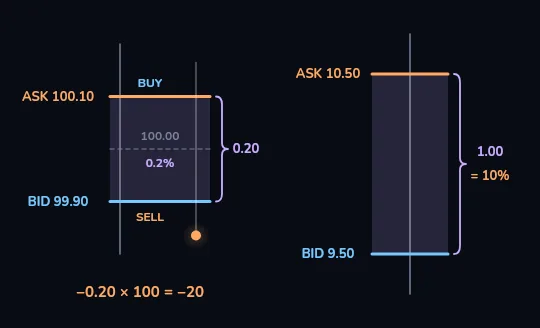
A thin market: 1.00 = 10% Beside the first axis, a second, much taller gap shows a thinly traded asset: ask 10.50, bid 9.50, and a brace reading 1.00 = 10%. The first market's 0.20 gap stays on the left for comparison. In the thin one, 10% of the price is gone on entry.
Check yourself
In the thin market in the last frame, you buy at 10.50 and have to sell at once. Roughly what share of your money is gone?
- About 0.2%
- About 1%
- About 10%
- Nothing, since the price didn't move
Show the answer
About 10%
Right. You pay 10.50 and get 9.50 back: 1.00 lost on a price of about 10, roughly 10%.
Lesson recap
- To buy now you pay the ask; to sell now you get the bid. The ask is always higher.
- Spread = ask − bid. With 100.10 and 99.90 it is 0.20, or 0.2% of the mid price, 100.00.
- Buying and selling at once loses the spread: 100 shares × 0.20 = 20, before any fees.
- Market makers earn the spread for always quoting both sides; zero commission does not mean zero cost.
- Compare spreads in percent: 1.00 on a price of 10 is 10%. Spreads widen around news, at the open and close, off hours and in thin assets.
- Education, not financial advice: this lesson explains a cost, not a trade to make.