
Market orders and limit orders
Choose between getting filled for sure and getting your price for sure, and see slippage when a market order walks up the book.
The two basic orders
Market order
"Buy (or sell) now, at the best price available."
Fill: almost certain in a normal market. Price: not certain. It takes whatever is waiting in the book, so it removes liquidity.
Limit order
"Buy at this price or lower" (or "sell at this price or higher").
Price: certain, or better. Fill: not certain. It may wait, fill only partly, or never fill. While it waits, it sits in the book and adds liquidity.
Check yourself
Which order guarantees the price, but not that it will fill?
- A market order
- A limit order
- Both do
- Neither does
Show the answer
A limit order
Right. A limit order never trades worse than your price, but if the market never comes to it, nothing happens.
WALKING THE BOOK
A big market order climbs the ladder
A market order doesn't get "the price on the screen". It takes the cheapest shares waiting, and if there aren't enough there, it moves up to the next level, and the next, until it is complete. The difference between the price you expected and the average price you actually got is called slippage. It grows with the size of your order, with thin books and with fast-moving markets.
The best ask is 100.10, but only 200 shares are for sale there. Buy 500 at market and the other 300 have to come from 100.20.
MARKET BUY 500
asks: 100.10 × 200 | 100.20 × 400 | 100.30 × 300

200 @ 100.10 = 20,020
300 @ 100.20 = 30,060
500 total    = 50,080

average:   50,080 ÷ 500 = 100.16
expected:  500 × 100.10 = 50,050
slippage: 50,080 − 50,050 = 30Average 100.16 · slippage 30The screen said 100.10, and the first 200 shares did cost that. The rest cost more because the cheapest level ran out. 30 extra on a 50,000 order is small here, because this book is fairly deep. In a thin book the same order could climb much further.
Check yourself
The asks are 100.10 × 200 and 100.20 × 400. You send a market buy for 500. What is your average price?
- 100.10
- 100.14
- 100.16
- 100.20
Show the answer
100.16
Right. 200 at 100.10 plus 300 at 100.20 is 50,080. Divided by 500 shares, that is 100.16.
What makes slippage bigger
- Order size: the more you need, the more levels you climb.
- Thin books: little waiting near the price means each level runs out fast.
- Fast markets: around news, the book can change between the moment you tap and the moment your order arrives.
- The open and the close: spreads are wider and the book is still settling.
Check yourself
Slippage is a fee that the broker adds to every market order.
Show the answer
False
False. Slippage isn't a charge anyone sets. It is the difference between the price you expected and the prices you actually got, because your order used up the cheapest shares and had to take dearer ones.
WAITING FOR YOUR PRICE
A limit order sits in the book
Same goal, different order: a limit buy of 500 at 100.00. Nobody is selling at 100.00, so it doesn't trade. It joins the book on the bid side and, at 100.00, becomes the new best bid. If sellers come down to 100.00 it fills, maybe only partly (a partial fill). If the price runs up to 101 instead, it never fills and you simply miss the move. A limit buy placed above the ask, say at 100.20, fills straight away, like a market order with a ceiling: it can take 100.10 and 100.20 but never pay more.
Orders also carry a time in force: a day order is cancelled at the close, and a good-till-cancelled order waits until it fills or you cancel it. Stop orders come in lesson 8.
Check yourself
Reza places a limit buy at 100.00. Over the next hour the price rises to 101 without ever trading at 100.00. What happened to his order?
- It filled at 101, the new price
- It filled at 100.00 anyway
- Nothing filled; it is still waiting or has expired
- It turned into a market order when the price moved away
Show the answer
Nothing filled; it is still waiting or has expired
Right. A limit buy never pays more than its limit. If the market never comes down to 100.00, the order just waits, or is cancelled at the end of its time in force.
Check yourself
Which order type does each description fit?
- Fills almost for sure, at whatever the book offers
- Never pays more than the price you set
- Can wait for hours and never fill
- Can suffer slippage in a thin book
- Adds liquidity while it waits in the book
- Takes liquidity from the book straight away
Show the answer
Market order: Fills almost for sure, at whatever the book offers, Can suffer slippage in a thin book, Takes liquidity from the book straight away
Limit order: Never pays more than the price you set, Can wait for hours and never fill, Adds liquidity while it waits in the book
Step through it
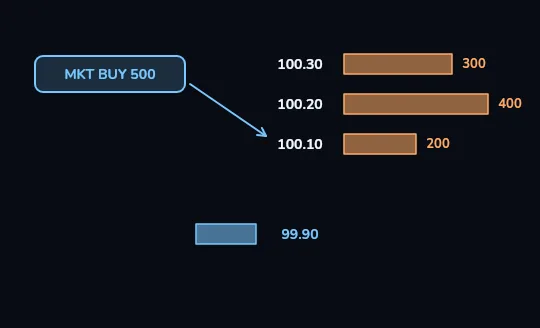
MKT BUY 500 arrives at the asks The ask ladder shows 200 shares at 100.10, 400 at 100.20 and 300 at 100.30, with the bid at 99.90 below. A blue box, MKT BUY 500, points at the cheapest level. A market order to buy 500 will take whatever sellers offer, cheapest first.
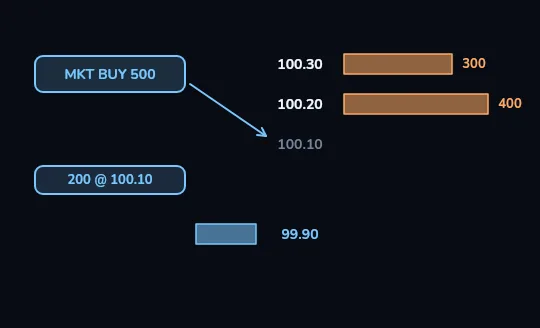
200 @ 100.10: the first level is gone The 100.10 bar empties and its price fades, and a first fill ticket appears: 200 @ 100.10. Only 200 were for sale at the best ask, so the order took all of them and still needs 300 more.
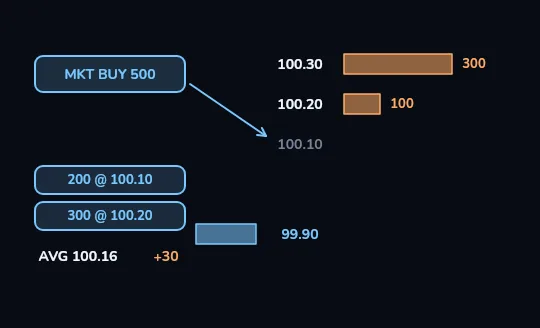
300 @ 100.20, average 100.16 The order takes 300 of the 400 at 100.20, leaving 100 on that bar, and a second ticket reads 300 @ 100.20. The summary shows AVG 100.16 and +30: in total the order cost 30 more than 500 shares at the 100.10 on the screen. That extra is slippage.
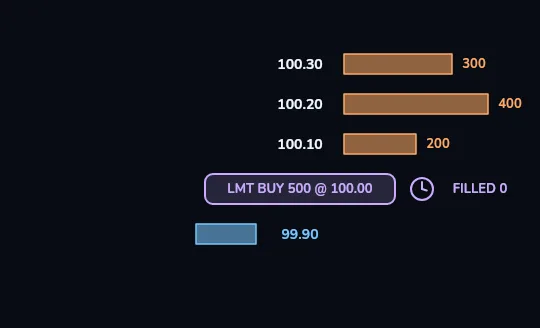
LMT BUY 500 @ 100.00 waits The book is reset to 200, 400 and 300. This time a lilac box, LMT BUY 500 @ 100.00, slides into the gap between the asks and the 99.90 bid and sits there, with a clock beside it and FILLED 0. It will never pay more than 100.00, but if the price never comes down to it, nothing fills.
Check yourself
With the same asks, you send a limit buy for 500 at 100.20 instead. What happens?
- Nothing, because 100.20 is above the best ask
- It fills at once: 200 at 100.10 and 300 at 100.20, never paying more than 100.20
- It fills all 500 at 100.20
- It waits until the price drops to 100.00
Show the answer
It fills at once: 200 at 100.10 and 300 at 100.20, never paying more than 100.20
Right. A limit above the ask trades immediately with everything priced at or below the limit. Here that is the same fill as the market order, but it could never have reached 100.30.
Lesson recap
- A market order fills almost for sure but not at a known price; a limit order gets your price or better but may never fill.
- A market order walks up the book: buying 500 took 200 at 100.10 and 300 at 100.20, an average of 100.16.
- Slippage is the gap between the price you expected and the price you got: 30 in that example. It grows with size, thin books and fast markets.
- A limit buy below the ask waits in the book and may fill partly or not at all; a limit above the ask fills at once with a price cap.
- Day orders expire at the close; good-till-cancelled orders wait, so keep track of them.
- Education, not financial advice: this lesson explains order types, not when to use them.