
Stop-losses: where you admit you were wrong
Place a stop-loss where your idea is proven wrong, see how it turns into a market order, and learn how gaps and slippage can push the loss past it.
Stop-loss (stop order)
An order that sits dormant until the price reaches a level you chose, the stop price. At that moment it wakes up and becomes a market order, which sells at the next available price. It is a plan for being wrong, written down while you are still calm.
You hold 50 shares bought at 50 with a stop at 48. While the price stays above 48 the order does nothing. When a trade prints at 48, it becomes a market order to sell 50 shares.
Check yourself
The price reaches the stop level of a plain stop-loss order. What does the order become?
- A market order, which sells at the next available price
- A limit order that sells only at exactly the stop price
- A request to the broker to wait and see
- Nothing: the stop just sends a notification
Show the answer
A market order, which sells at the next available price
Right. A plain stop becomes a market order. It will get out, but at whatever price is available at that moment.
Two kinds of stop
Stop (stop-market)
At the stop price it becomes a market order.
It will get you out, but the price can be worse than the stop in a fast market.
Stop-limit
At the stop price it becomes a limit order at a price you set.
It will not sell below that limit, so in a sharp fall it may not fill at all and you stay in the losing trade.
WHERE IT GOES
Put the stop where the idea is wrong
A stop belongs at the price that proves your reason for the trade wrong, for example just below a support zone from lesson 6. Not at a round sum of money you "don't mind" losing. Too tight, and ordinary ups and downs knock you out of a trade that was fine. Too wide, and the position has to be small. Either way, the stop comes first and the size follows it, as in lesson 7.
If you bought because the price kept bouncing near 48.50, a stop just under that zone, say 48, says: if it breaks this, I was wrong. A stop at 49.80 would be hit by normal noise.
Check yourself
Mina is deciding where to put her stop-loss. Which approach matches this lesson?
- At the price where her reason for the trade would be proven wrong, then size the position from it
- At whatever price means losing a round 500, since that feels bearable
- As close to the entry as possible, so any loss stays tiny
- No stop at all, so normal noise can never knock her out
Show the answer
At the price where her reason for the trade would be proven wrong, then size the position from it
Right. The stop marks where the idea fails. Then lesson 7's formula turns that distance into a share count, so the loss stays within her risk rule.
Step through it
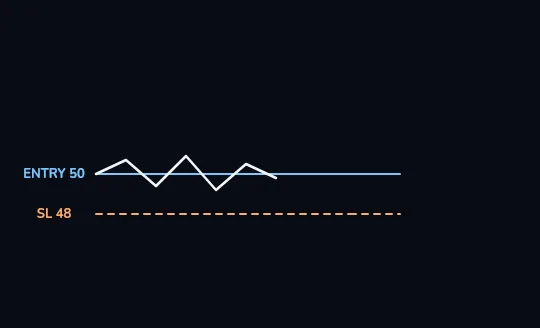
Entry 50, stop-loss 48 A blue line marks the entry at 50 and a dashed orange line marks the stop-loss (SL) at 48. The price line wiggles between 49 and 51. Normal ups and downs do not touch the stop.
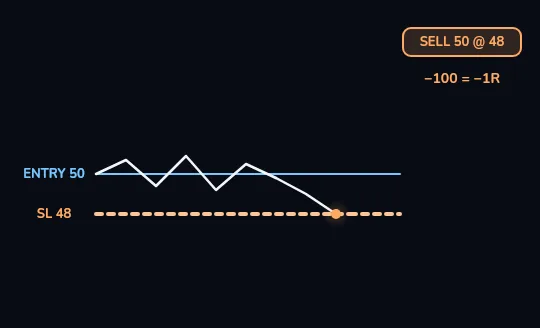
The stop fires at 48: −100 = −1R The price drops to 48 and the dashed stop line lights up where they meet. The stop becomes a market order: SELL 50 @ 48. The loss is 50 × 2 = 100, which is −1R, exactly the amount planned in lesson 7 (fees aside).
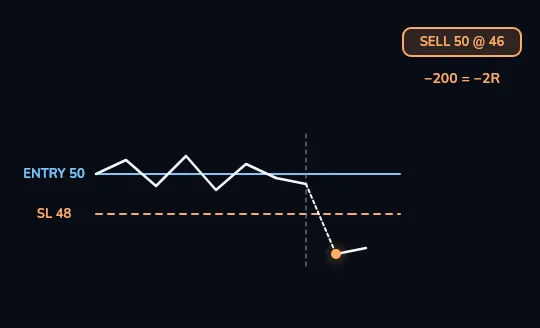
A gap: closes at 49.50, opens at 46 Start again. The price line ends at 49.50 at a dashed vertical close marker. Bad news arrives overnight, and a dotted jump shows the next day opening at 46, below the stop, with no trades in between. The stop sells at 46, not 48: 50 × 4 = 200, twice the plan. A stop does not guarantee its price.
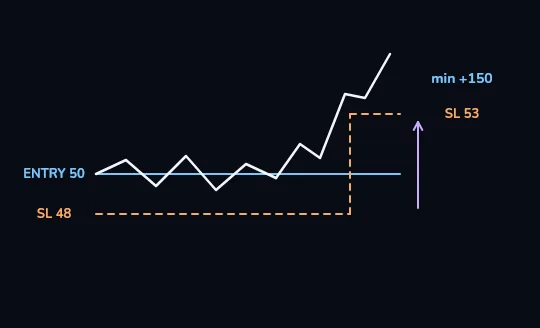
A trailing stop moves up to 53 Start again. This time the price climbs to 56, and the dashed stop line steps up behind it from 48 to 53, next to a lilac arrow pointing up. A trailing stop follows the price up but never down. Even if it is hit now, the trade keeps a gain of about 3 × 50 = 150.
Check yourself
Reza holds 50 shares bought at 50, stop at 48. After bad news overnight, the price opens at 46. Roughly what does he lose?
- About 100, because the stop was at 48
- About 200
- Nothing, the stop protects him completely
- About 2,300, the whole position
Show the answer
About 200
Right. The first available price is 46, so the stop sells there: 4 per share × 50 shares = about 200, double the planned 100.
Check yourself
A stop-loss at 48 guarantees that you will never sell below 48.
Show the answer
False
False. A plain stop becomes a market order at 48 and sells at the next available price. If the price gaps or moves fast, that price can be well below 48. A stop limits losses in normal trading; it does not guarantee a price.
Check yourself
Ali's trade is falling towards his stop at 48. He thinks about lowering the stop to 45 "just to give it some room". What does that do?
- It is smart patience: most trades come back
- It raises his possible loss beyond the plan, from 100 to 250 on 50 shares
- It lowers his risk, because the stop is less likely to be hit
- Nothing, as long as he does not tell anyone
Show the answer
It raises his possible loss beyond the plan, from 100 to 250 on 50 shares
Right. With 50 shares, a stop at 45 risks 5 × 50 = 250 instead of 100, and nothing stops him lowering it again. That is how a small planned loss becomes a large one.
Lesson recap
- A plain stop-loss waits until the stop price, then becomes a market order; a stop-limit becomes a limit order and may not fill.
- Put the stop where the trade idea is proven wrong, then size the position from it.
- At 48, the lesson's trade loses about 100 (−1R), as planned.
- A gap or slippage can fill the stop at a worse price: opening at 46 made it about 200. A stop does not guarantee its price.
- A trailing stop follows the price up but never down; and never move a stop further away to avoid a loss.