
Fees: the cost you pay on every trade
Add up commission, spread and financing on one trade, then over a year, and see how many trades a strategy must win just to stand still.
WHAT A TRADE COSTS
More than the commission line
A trade's cost has several parts. Commission: the broker's fee, often charged on the way in and again on the way out. Spread: the gap between bid and ask from lesson 3, paid every time you cross it. Slippage: getting a worse price than expected in a fast market (lessons 4 and 8). Financing or swap on leveraged or overnight positions (lesson 9). Sometimes currency conversion, and taxes where they apply.
A buy and the sell that closes it are one round trip. Most of these costs are paid on each half of it.
Check yourself
Match each cost to what it is
Show the answer
- Commission → The broker's fee for handling the order
- Spread → Buying at the ask and selling at the lower bid
- Slippage → Filling at a worse price than expected in a fast market
- Financing (swap) → A charge for holding a leveraged position overnight
Position                          10,000

Commission in    0.1% of 10,000  =    10
Commission out   0.1% of 10,000  =    10
Spread           0.1% of 10,000  =    10
                                  ------
One round trip 3030 on 10,000 = 0.3% per round trip.
The trade must gain more than 0.3% before it earns anything.0.3% sounds like nothing. The next step is to multiply it by how often you trade.
Check yourself
Hamid pays a commission of 10 to open a trade and 10 to close it, and the spread costs him another 10. What does one round trip cost?
- 10
- 20
- 30
- It is free if the trade makes a profit
Show the answer
30
Right. 10 in + 10 out + 10 spread = 30, paid whether the trade wins or loses.
THE MULTIPLIER
How often you trade decides what costs take
One round trip costs the same whoever makes it. What differs is turnover: how many round trips you make. Two a week for fifty weeks is 100 round trips a year. At 30 each, that is 3,000, which is 30% of a 10,000 account. A long-term holder who buys once and holds pays that round trip once (plus any yearly fund fee).
Two traders, identical skill, identical account. One trades twice a week, the other twice a year. Their results before costs may match; after costs they are nowhere near each other.
Step through it
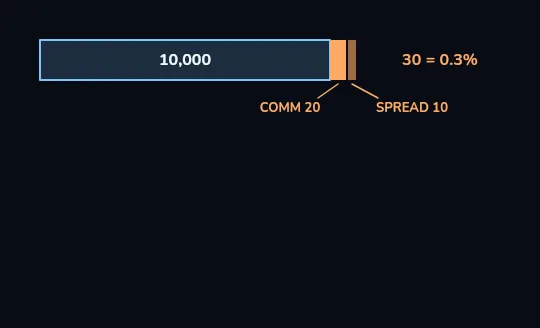
One round trip on 10,000: about 30 A trade ticket bar reads 10,000, with two small orange bites at its end: COMM 20 (commission in and out) and SPREAD 10. Together they make 30, which is 0.3% of the position. That is the cost of one round trip.
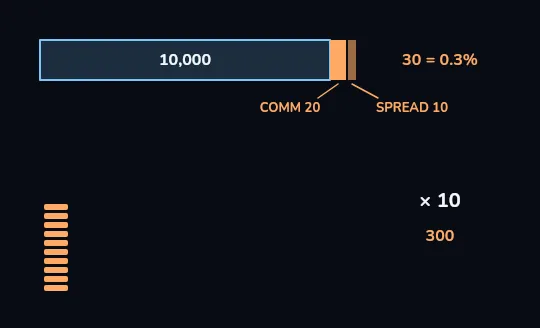
Ten round trips: 300 The ticket stays at the top. Below it, a counter reads × 10 and a column of ten small orange chips stacks up, one chip per round trip, totalling 300. Small on their own, but they add up.
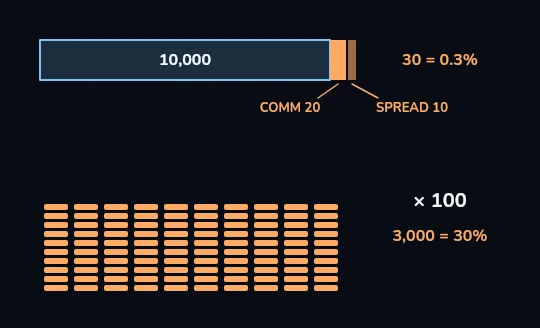
A hundred round trips: 3,000 = 30% The counter jumps to × 100 and the chips fill ten columns of ten. The total reads 3,000 = 30%. Two round trips a week for a year is about 100, and that sends 30% of a 10,000 account to costs.
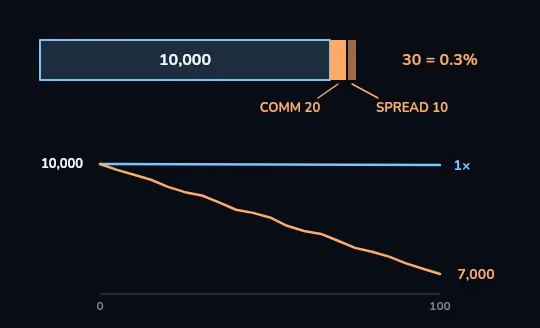
10,000 slides to 7,000; one trip stays flat The chips give way to a line chart from 0 to 100 round trips. The orange line is the account of a trader whose wins and losses cancel out: it still slides from 10,000 to 7,000, all of it costs. The blue line marked 1× is someone who paid for one round trip and stays almost flat. Costs are the only sure thing in a trade.
Check yourself
Over a year, Sima makes 100 round trips at about 30 each on a 10,000 account. Roughly how much do costs take?
- 300, which is 3%
- 3,000, which is 30%
- 30, which is 0.3%
- Nothing, if her wins and losses cancel out
Show the answer
3,000, which is 30%
Right. 100 × 30 = 3,000, which is 30% of 10,000. Even with wins and losses cancelling out, she ends the year near 7,000.
Check yourself
If an app charges zero commission, trading on it is free.
Show the answer
False
False. You still buy at the ask and sell at the bid, you can still get slippage, and the app may earn from a wider spread, from routing your orders or from interest on your cash. Only the commission line is zero.
Check yourself
Before Nazanin places a trade, which of these does she know for certain?
- Its profit
- Its costs
- Whether it will hit her stop
- How long she will hold it
Show the answer
Its costs
Right. The costs are fixed the moment she trades; the profit, the stop and the holding time are all unknown. Every trade has to beat its costs before it earns anything.
Lesson recap
- A trade's costs include commission, spread, slippage, and financing on leveraged or overnight positions, plus conversion and taxes where they apply.
- One round trip on 10,000 at 0.1% commission each way and 0.1% spread costs about 30, or 0.3%.
- Turnover is the multiplier: 100 round trips a year is about 3,000, 30% of a 10,000 account.
- "Zero commission" is not free: spreads, order routing and interest on cash still earn the broker money.
- Costs are certain and profits are not, so every trade has to beat its costs before it earns anything.