
From cells to systems
How cells team up into tissues, tissues into organs, and organs into the systems this course walks through one by one.
THE LADDER
Cell, tissue, organ, system, you
Each step up the ladder is a team made of the step below. A tissue is many similar cells doing one job together. An organ is several tissues working as one unit, like the heart or the stomach. An organ system is a group of organs that share a bigger job, like the heart, blood vessels and blood moving everything around. All the systems together make the organism: you.
Heart muscle cell → heart muscle tissue → the heart → the circulatory system → a person who can run for a bus.
Check yourself
Which list goes from smallest to largest?
- Tissue, cell, organ, system
- Cell, organ, tissue, system
- Cell, tissue, organ, system
- Organ, tissue, cell, system
Show the answer
Cell, tissue, organ, system
Right. Cells make tissues, tissues make organs, and organs make systems.
Step through it

One heart muscle cell We'll climb the ladder with the heart. Here is a single heart muscle cell on its own, a short rounded block with its nucleus as the dot in the middle, labelled 1.

Many cells of one kind: a tissue Pack many of those identical cells together and you get a tissue, here heart muscle tissue. The grid stands for thousands of cells, marked ×1000s, all doing the same job: contracting.
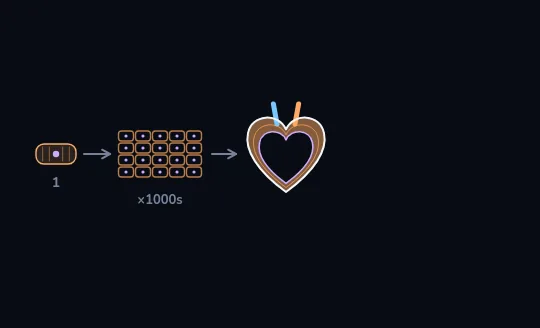
Several tissues together: an organ The row grows: cell, then tissue, then an organ, the heart. Its muscle tissue is wrapped with an outer layer and an inner lining, which you can see nested inside the heart shape; each layer is a different tissue, and together they work as one pump.
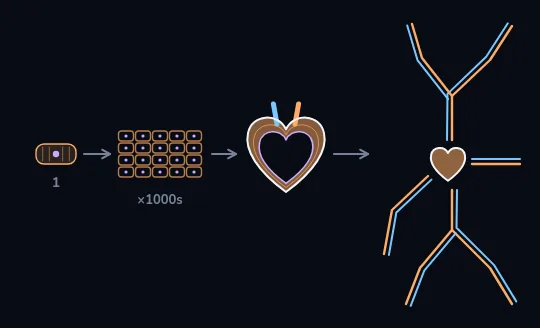
Organ plus vessels: a system At the end of the row, a smaller heart sits in the middle of a network of vessels branching out toward the edges, orange for blood rich in oxygen and blue for blood that has given it up. The heart plus the vessels and the blood inside them make one organ system: the circulatory system.
Check yourself
In the frames, the grid of thousands of identical heart muscle cells was an example of which level?
- A cell
- A tissue
- An organ
- An organ system
Show the answer
A tissue
Right. Many similar cells doing one job make a tissue. The heart only became an organ once several tissues were layered together.
The four basic kinds of tissue
- Epithelial: linings and coverings, like the surface of your skin and the inside of your gut.
- Connective: supports and binds, like bone, tendons and fat. Blood counts too: a connective tissue with a liquid in place of a solid.
- Muscle: contracts, to move bones, pump blood or squeeze food along.
- Nervous: carries electrical signals, in the brain, spinal cord and nerves.
WORKED EXAMPLE
The stomach uses all four
A tissue is one kind of layer; an organ mixes tissues. The stomach is a good example. Its inside is lined with epithelial tissue that makes acid and protective mucus. Around that sit layers of muscle that churn your food. Connective tissue holds the layers together and carries the blood vessels. And nerves tell the muscles when to squeeze.
Take away any one of the four and the stomach stops working as a stomach: no lining, no acid; no muscle, no churning; no nerves, no timing.
Check yourself
Which type of tissue covers and lines surfaces, like the inside of your gut?
- Connective
- Muscle
- Nervous
- Epithelial
Show the answer
Epithelial
Right. Epithelial tissue makes the linings and coverings: the skin's surface, the gut lining, the inside of your airways.
| System | Main parts | Where in this course |
|---|---|---|
| Skeletal and muscular | Bones, joints, muscles | Lesson 3 |
| Circulatory | Heart, blood vessels, blood | Lessons 4 and 5 |
| Respiratory | Airways, lungs, diaphragm | Lesson 6 |
| Digestive | Mouth to gut, liver, pancreas | Lesson 7 |
| Urinary | Kidneys, bladder | Lesson 8 |
| Immune and lymphatic | White blood cells, lymph nodes | Lesson 9 |
| Nervous | Brain, spinal cord, nerves | Lesson 10 |
| Endocrine | Glands and hormones | Lesson 11 |
| Integumentary | Skin, hair, nails | In passing, lessons 9 and 12 |
| Reproductive | Reproductive organs | Not covered in this course |
Check yourself
The pancreas belongs to only one system, the digestive system.
Show the answer
False
False. The pancreas makes digestive juices that go into the gut, so it's part of the digestive system. It also releases hormones such as insulin into the blood, so it's part of the endocrine system too. One organ can serve more than one system.
Homeostasis
Keeping conditions inside the body steady while the world outside changes. Your systems all serve this one goal: holding your core temperature near 37 °C, and keeping blood sugar, water and oxygen within narrow ranges. When something drifts, the body notices and pushes it back.
On a hot day you sweat to cool down; on a cold one you shiver to make heat. Two opposite responses, one goal: a core temperature that stays close to 37 °C.
Check yourself
Which of these best describes homeostasis?
- Keeping conditions inside the body steady while the outside changes
- Making every cell in the body the same
- Growing new cells to replace old ones
- Letting body temperature follow the weather
Show the answer
Keeping conditions inside the body steady while the outside changes
Right. Temperature, blood sugar, water and oxygen are all held within narrow ranges, whatever is happening outside. Lesson 12 comes back to this with a sprint for the bus.
Lesson recap
- The ladder: cell → tissue → organ → organ system → you.
- A tissue is many similar cells doing one job; there are four basic kinds: epithelial, connective, muscle and nervous.
- An organ mixes several tissues, like the stomach using all four. Blood is a tissue too, a connective one.
- About 11 systems share the work, and one organ can belong to more than one, like the pancreas.
- They all serve homeostasis: keeping temperature, blood sugar, water and oxygen steady inside you.