
Hormones: the slow messengers
How glands send chemical messages through the blood, how insulin and glucagon keep blood sugar steady, and what adrenaline does in a hurry.
CHEMICAL LETTERS
Sent to everyone, read only by some
Endocrine glands release hormones into the blood, and the blood carries them everywhere. Yet each hormone affects only certain organs. That's because only cells with the matching receptor respond, like a lock that only one key fits; all other cells ignore it. Compared with nerves, hormones are slower (seconds to hours, or longer), reach many organs at once, and their effects last longer.
Adrenaline reaches your whole body within seconds, but it speeds up your heart and widens your airways because those cells carry adrenaline receptors. Your hair cells don't, so your hair doesn't react.
Check yourself
A hormone travels in the blood to every part of the body. Why does it change what some organs do but not others?
- It gets used up before it reaches the other organs
- The other organs have no blood supply
- It only works on organs close to the gland that made it
- Only cells with the matching receptor respond to it
Show the answer
Only cells with the matching receptor respond to it
Right. The hormone reaches almost everywhere, but only cells carrying its receptor can read the message, like a lock that only that key fits.
Step through it
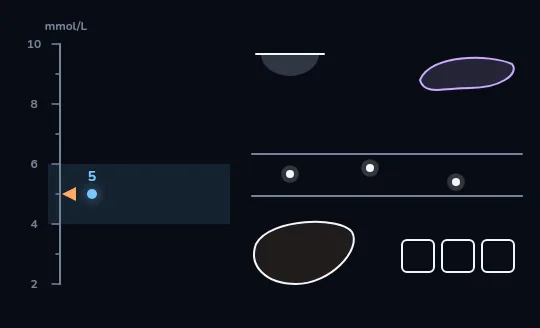
Between meals: steady at 5 The gauge on the left shows blood sugar in mmol/L, the unit used in most countries. Between meals the needle sits at 5, inside the shaded band from 4 to 6 where a healthy body keeps it. On the right: a bowl for meals, the pancreas (lilac), a blood vessel carrying a few glucose dots (white), the liver, and three body cells, still empty.
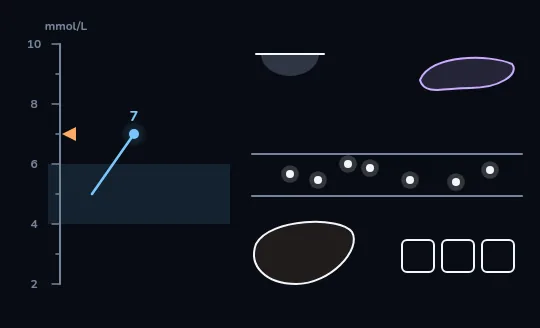
After a meal: glucose pours in You've eaten. Glucose from digestion (lesson 7) pours into the blood, and the vessel fills with white dots. The trace climbs and the needle rises to 7, above the band. On its own, the level would stay high.
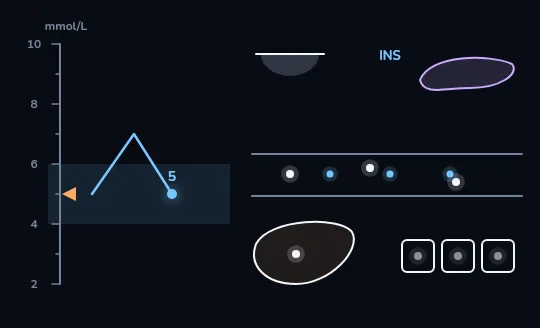
Insulin: cells take the glucose in The pancreas notices the rise and releases insulin, the blue dots marked INS. Insulin is the signal that lets cells take glucose in: the white dots move out of the blood into the three cells, and into the liver, which stores some for later. The level falls, and the needle comes back to 5.
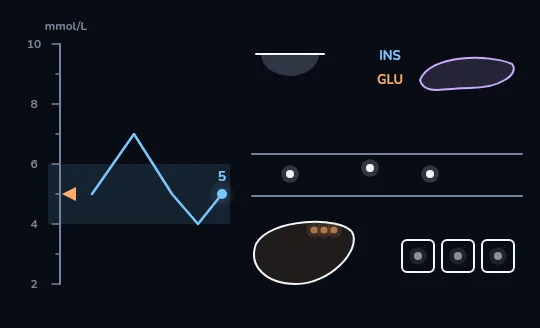
Glucagon: the liver releases its store Hours later, with no food coming in, the trace drifts down to 4. Now the pancreas releases the opposite hormone, glucagon, marked GLU (orange dots). It reaches the liver, which releases some of its stored glucose back into the blood, and the needle returns to 5. Two opposite hormones hold the level steady: 5, 7, 5, 4, 5.
Check yourself
After a meal your blood sugar rises. Which hormone brings it back down?
- Insulin
- Glucagon
- Adrenaline
- ADH
Show the answer
Insulin
Right. Insulin from the pancreas lets cells take glucose in and the liver store some, so the level falls back into its band.
Negative feedback
A control loop in which a change sets off a response that pushes it back the other way. Too high triggers something that lowers it; too low triggers something that raises it. It's the main way the body keeps its inside steady (homeostasis, lesson 2).
A room thermostat: when the room gets too warm the heater switches off, when it gets too cold it switches on. Blood sugar works the same way, with insulin and glucagon as the two switches.
Some main glands and one job each
- Pituitary, at the base of the brain: the "master" gland that directs several others. It also releases ADH, which tells the kidneys how much water to keep (lesson 8).
- Thyroid, in the neck: sets the pace of your metabolism, how fast your cells use energy.
- Adrenal glands, on top of the kidneys: adrenaline for sudden action, and cortisol for longer stress.
- Pancreas: insulin and glucagon for blood sugar. It's also a digestive organ (lesson 7).
- Ovaries and testes: sex hormones, important in puberty and throughout adult life.
Check yourself
Compared with nerve signals, hormone messages are generally slower to arrive but last longer.
Show the answer
True
True. A nerve signal arrives in milliseconds and is over almost at once. A hormone takes seconds to hours to act through the blood, but its effect can last minutes, hours or longer.
FIGHT OR FLIGHT
Adrenaline: the hormone for a hurry
When you get a fright, or suddenly need to run, your adrenal glands release adrenaline within seconds. Your heart beats faster and harder, breathing quickens and your airways widen, the liver releases stored glucose for fuel, and blood is sent toward your muscles and away from your gut. It's often called the fight-or-flight response. Because it travels in the blood, the effect fades over minutes, not the instant the danger passes.
You nearly miss the bottom step on the stairs. You catch yourself in a split second (that's your nerves), but your heart keeps pounding for a minute or two afterwards (that's adrenaline).
Check yourself
Reza is running for the bus when a car horn blasts right beside him. His heart pounds and he breathes harder for a while afterwards. Which hormone is mainly behind that?
- Insulin
- Glucagon
- Adrenaline
- ADH
Show the answer
Adrenaline
Right. Adrenaline from the adrenal glands speeds the heart, quickens breathing and releases fuel within seconds, and because it's carried in the blood, the effect lingers for a few minutes.
Check yourself
Sort each event into the hormone that causes it
- Released after a meal
- Cells take in glucose
- The liver stores glucose for later
- Released when blood sugar drifts low
- The liver releases stored glucose
- A low level rises back
Show the answer
Insulin (INS): Released after a meal, Cells take in glucose, The liver stores glucose for later
Glucagon (GLU): Released when blood sugar drifts low, The liver releases stored glucose, A low level rises back
Lesson recap
- Endocrine glands release hormones into the blood; only cells with the matching receptor respond.
- Hormones are slower than nerves but reach many organs and last longer.
- Negative feedback, like a thermostat, pushes a change back the other way.
- Blood sugar: after a meal, insulin lets cells take glucose in; between meals, glucagon tells the liver to release its store. Together they hold it near 5 mmol/L.
- Adrenaline, the fight-or-flight hormone, speeds the heart and breathing and releases fuel within seconds.