
The heart: a double pump
The heart's four chambers, the two circuits they pump, and what the valves and the "lub-dub" are doing.
WHERE AND WHAT
A muscular pump about the size of a fist
Your heart is a hollow pump made of cardiac muscle, about the size of your fist. It sits in your chest between the lungs, near the middle, tilted so that its tip points to the left. That tilt is why you feel the beat more on the left side, and why people often think the heart is on the far left.
Put your hand flat on the centre of your chest, just a little to the left of the breastbone: that's roughly where it is, not out by your left armpit.
FOUR ROOMS, TWO PUMPS
Atria receive, ventricles pump
The heart has four chambers. The two on top, the atria (one is an atrium), receive blood coming in. The two below, the ventricles, pump it out. A wall called the septum separates the right side from the left. The right side pumps oxygen-poor blood a short way, to the lungs. The left side pumps oxygen-rich blood to the whole body, so the left ventricle has a much thicker, stronger wall.
In textbook drawings the heart faces you, so its right side is on your left. RA means right atrium, LV left ventricle, and so on.
Check yourself
Which chamber pumps oxygen-rich blood out to the whole body?
- Right atrium
- Right ventricle
- Left atrium
- Left ventricle
Show the answer
Left ventricle
Right. The left ventricle does the heavy lifting, which is why its wall is the thickest of the four.
Step through it
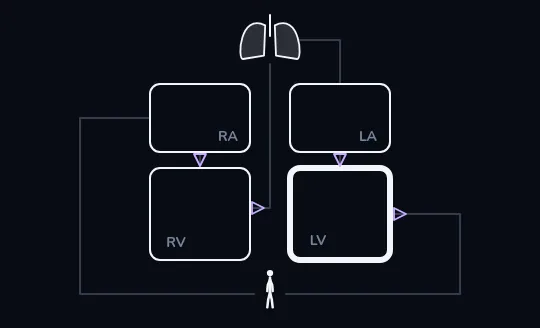
Four chambers, no blood yet Four chambers: the two atria on top (RA, LA) receive, and the two ventricles below (RV, LV) pump. The thick outline is the left ventricle. The small triangles are valves, the lungs sit at the top and the body figure at the bottom; no blood is moving yet.
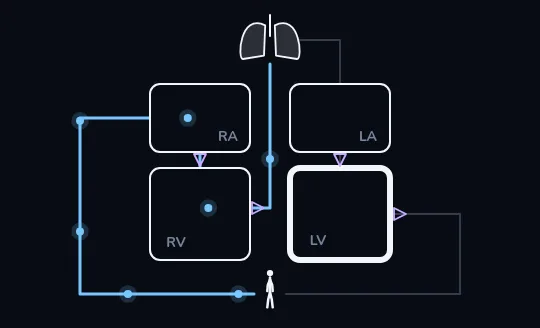
The right side sends blood to the lungs Oxygen-poor blood (blue dots) comes back from the body into RA, passes a valve into RV, and is pumped up to the lungs. Real oxygen-poor blood is dark red, not blue; the colour here just marks that it has given up its oxygen.
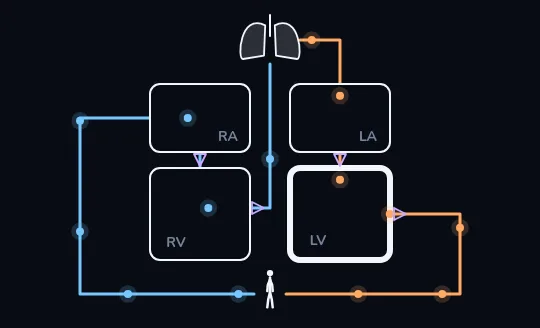
The left side sends blood to the body Refreshed, oxygen-rich blood (orange dots) comes back from the lungs into LA, passes a valve into LV, and the thick-walled left ventricle pumps it out through the aorta, the body's main artery, to the whole body.
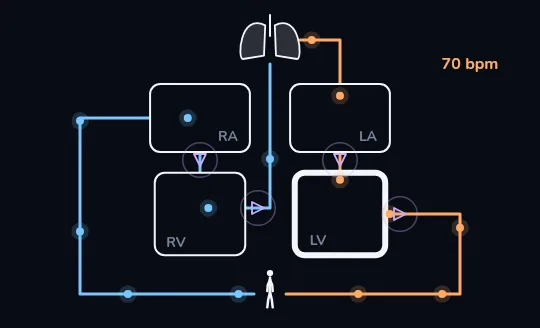
Both sides beat together Both sides squeeze at the same time, in a steady rhythm, and each valve flicks shut with a small pulse ring. The counter reads 70 bpm: about 70 beats a minute at rest. Each lub-dub you hear is valves snapping shut.
Check yourself
Using the frames, which route does one drop of blood take on a full round trip?
- Body → left atrium → left ventricle → lungs → right atrium → right ventricle → body
- Body → right atrium → right ventricle → lungs → left atrium → left ventricle → body
- Body → right ventricle → right atrium → lungs → left ventricle → left atrium → body
- Lungs → right atrium → left atrium → body → right ventricle → left ventricle → lungs
Show the answer
Body → right atrium → right ventricle → lungs → left atrium → left ventricle → body
Right. Blood from the body enters the right side and goes to the lungs; back from the lungs it enters the left side and goes to the body. Always atrium first, then ventricle.
ONE-WAY DOORS
Valves, and where the lub-dub comes from
Four valves act as one-way doors: blood can push them open going forward, but if it tries to flow backwards they slam shut. The familiar lub-dub of a heartbeat is the sound of these valves closing. Lub is the valves between the atria and the ventricles shutting as the ventricles start to squeeze. Dub is the valves at the exits shutting as the squeeze ends.
A doctor's stethoscope listens for a clean lub-dub. An extra swishing sound, called a murmur, can mean blood is squeezing through a valve that doesn't open or close fully, though many murmurs are harmless.
Check yourself
What makes the "lub-dub" sound of a heartbeat?
- Blood hitting the walls of the arteries
- The heart muscle rubbing against the lungs
- The valves inside the heart snapping shut
- Air moving in the chest with each beat
Show the answer
The valves inside the heart snapping shut
Right. Lub is the valves between atria and ventricles closing; dub is the exit valves closing.
THE BUILT-IN SPARK
The heart starts its own beats
Each beat begins with an electrical signal from a small patch of special cells in the right atrium, the sinoatrial node (SA node), the heart's natural pacemaker. The signal spreads across the atria, then down to the ventricles, so the top squeezes just before the bottom. The heart doesn't need the brain to start each beat. Nerves and hormones such as adrenaline only speed it up or slow it down.
This is why a heart can keep beating for a while even after it has been removed for a transplant: the pacemaker is inside the heart itself.
Check yourself
The heart needs a signal from the brain to start every single beat.
Show the answer
False
False. Every beat starts in the heart's own pacemaker, the SA node in the right atrium. The brain, through nerves and hormones, can only make the beats faster or slower.
The heart in numbers (typical healthy adult at rest)
- Resting heart rate: usually about 60 to 100 beats a minute; very fit people can be lower.
- Each beat pushes roughly 70 ml out of each ventricle.
- That adds up to about 5 litres a minute at rest, and several times more during hard exercise.
- Your pulse, at the wrist or the side of the neck, is the pressure wave of each beat. Count it for 30 seconds and double it to get beats per minute.
Check yourself
- The right ventricle pushes blood a short distance, to the lungs right next to the heart. Its wall is fairly thin.
- The left ventricle pushes blood all the way to your toes, your brain and everywhere in between. Its wall is about three times thicker.
What rule explains the difference between the two walls?
- The left side of the body is always stronger than the right
- The left ventricle holds much more blood than the right
- The farther and wider a chamber has to push blood, the more muscle it needs
- The right ventricle is younger and hasn't finished growing
Show the answer
The farther and wider a chamber has to push blood, the more muscle it needs
Exactly. Both ventricles push about the same amount of blood with each beat, but the left has to drive it through the whole body at higher pressure, so it carries more muscle.
Lesson recap
- The heart is a fist-sized muscular pump, between the lungs near the middle of the chest, tilted left.
- Two atria on top receive blood; two ventricles below pump it out.
- It's a double pump: the right side sends oxygen-poor blood to the lungs, the left side sends oxygen-rich blood to the body, so the left ventricle's wall is thickest.
- Valves are one-way doors; the lub-dub is them snapping shut.
- The SA node starts every beat by itself; nerves and hormones only speed it up or slow it down. At rest that's typically 60 to 100 beats a minute, about 5 litres of blood a minute.