
Blood and vessels: the delivery network
What blood is made of, the difference between arteries, veins and capillaries, and where the real delivery happens.
WHAT'S IN IT
About 5 litres, just over half of it liquid
An adult has roughly 5 litres of blood (about 4.5 to 5.5, less in smaller people). About 55% is plasma, a yellowish liquid that's mostly water, carrying sugar, salts, proteins, hormones, carbon dioxide and waste. The other 45% is cells, nearly all of them red blood cells, with a small share of white blood cells and platelets.
Leave a tube of blood to settle in a lab machine and it separates: a straw-coloured layer of plasma on top, a dark red layer of red cells at the bottom, and a thin pale band of white cells and platelets in between.
The four parts of blood
- Plasma: the liquid that carries everything dissolved in it, from glucose to hormones to CO2.
- Red blood cells: carry oxygen using haemoglobin, a protein that contains iron. Each one lives about 120 days.
- White blood cells: the body's defenders against germs (lesson 9).
- Platelets: small cell fragments that rush to a cut and start a clot to plug it.
Check yourself
Arash cuts his finger chopping onions. Which part of his blood starts the clot that stops the bleeding?
- Red blood cells
- Platelets
- Plasma water
- Haemoglobin
Show the answer
Platelets
Right. Platelets gather at the cut and start the clot that plugs it.
Step through it
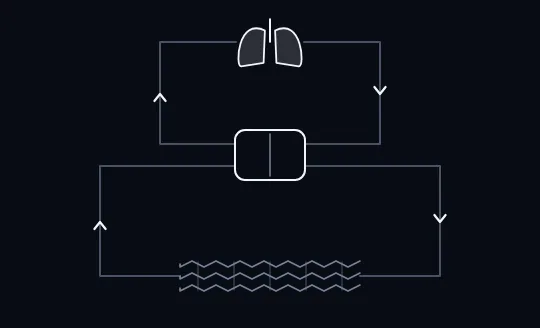
Two loops, one heart Blood travels in a figure of eight through one heart, the box in the middle. The short upper loop goes to the lungs; the long lower loop goes to the body, whose zigzag mesh at the bottom stands for its capillaries. The arrowheads show the direction of flow.
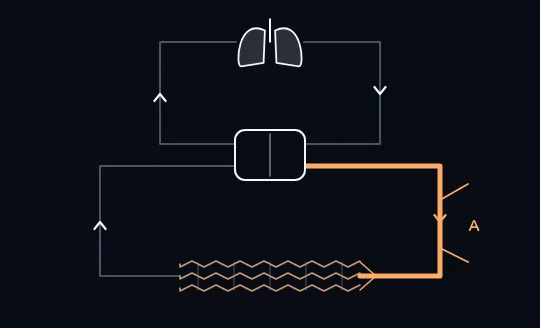
Arteries carry blood away The outgoing side of the body loop turns thick and orange: an artery, labelled A, carrying oxygen-rich blood away from the heart under pressure. It sends off side branches and ends in the thin vessels of the mesh, splitting smaller and smaller.
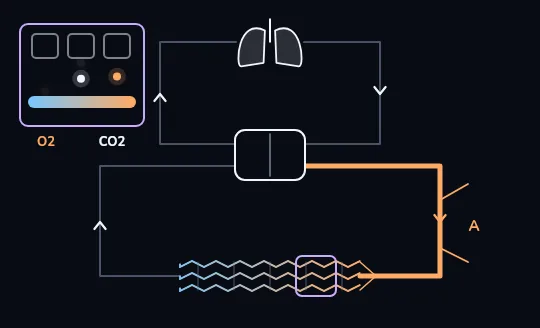
Capillaries: where delivery happens The box at the top left zooms in on one capillary, marked by the small square on the mesh. Its wall is just one cell thick, so oxygen (O2) passes out to the three body cells above it and carbon dioxide (CO2) passes in. Along its length the blood shades from orange, rich in oxygen, to blue, having given it up.
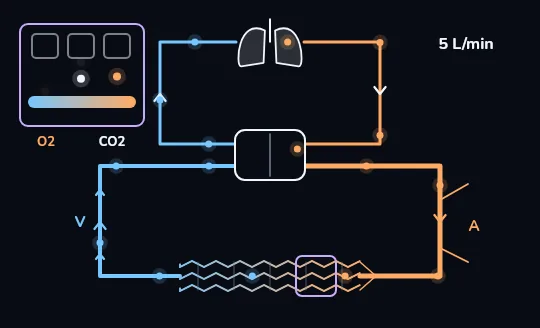
Veins bring it back, the lungs refresh it The return side turns blue: a vein, labelled V, whose small chevrons are one-way valves, carrying blood back to the heart. From there it goes up the lungs loop blue and comes back orange, refreshed. Dots now circle the whole figure of eight: about 5 L/min, 5 litres a minute at rest.
Check yourself
From the frames: where do oxygen and food actually leave the blood to reach your cells?
- In the arteries, while the pressure is high
- In the capillaries, through walls one cell thick
- In the veins, on the way back to the heart
- Inside the heart, before the blood is pumped out
Show the answer
In the capillaries, through walls one cell thick
Right. Arteries and veins are the motorways; capillaries are the side streets where the parcels are handed over. Nearly every cell in your body sits close to one.
Arteries and veins
Arteries
Carry blood away from the heart.
Thick, elastic, muscular walls; high pressure. Each heartbeat stretches them, and that stretch is the pulse you feel at your wrist.
Veins
Carry blood back to the heart.
Thinner walls; low pressure. One-way valves stop blood sliding back, and when you walk, your leg muscles squeeze the veins and help push blood up toward the heart.
THE CLASSIC TRAP
Named by direction, not by oxygen
It's tempting to think arteries carry oxygen-rich blood and veins carry oxygen-poor blood. Usually true, but that isn't the definition. An artery is any vessel carrying blood away from the heart; a vein carries it back. So the pulmonary artery, from the heart to the lungs, carries oxygen-poor blood, and the pulmonary veins, from the lungs back to the heart, carry oxygen-rich blood.
In the figure of eight, the vessel going up to the lungs was blue, yet it's an artery: it leaves the heart.
Check yourself
Every artery in the body carries oxygen-rich blood.
Show the answer
False
False. The pulmonary artery carries oxygen-poor blood from the heart to the lungs. Arteries are defined by direction, away from the heart, not by how much oxygen they carry.
TWO NUMBERS
Reading a blood pressure like 120/80
Blood pressure is the push of blood against artery walls, measured in mmHg. It's written as two numbers. The top one, systolic, is the pressure while the heart is squeezing. The bottom one, diastolic, is the pressure between beats, while the heart relaxes and refills. For adults, readings that stay at or above about 130/80 (US guidance) or 140/90 (WHO) are generally considered high, but only a clinician can diagnose it, from several readings.
High blood pressure often causes no symptoms at all for years. That's exactly why it's measured at check-ups rather than waited for.
Check yourself
A blood pressure reading says 120/80. What does the 120 mean?
- The pressure while the heart is squeezing
- The pressure between beats
- The number of heartbeats in two minutes
- The amount of blood pumped per beat, in ml
Show the answer
The pressure while the heart is squeezing
Right. The top number, systolic, is the peak pressure during the squeeze; the bottom one, diastolic, is the pressure between beats.
Check yourself
Match each part of the delivery network to its job
Show the answer
- Artery → Carries blood away from the heart under high pressure
- Capillary → Wall one cell thick, where oxygen and waste are swapped
- Vein → Carries blood back to the heart, with one-way valves
- Red blood cell → Carries oxygen using haemoglobin
Lesson recap
- An adult has roughly 5 litres of blood: about 55% plasma and 45% cells.
- Red cells carry oxygen with iron-rich haemoglobin; white cells defend; platelets start clots.
- Arteries carry blood away from the heart under high pressure; veins bring it back at low pressure, helped by valves and leg muscles.
- Capillaries, one cell thick, are where oxygen and food reach cells and CO2 and waste are collected.
- Vessels are named by direction: the pulmonary artery carries oxygen-poor blood. Blood pressure like 120/80 is the squeeze over the pause, and only a clinician can diagnose high blood pressure.