
Bones and muscles: the frame that moves
What bones do besides hold you up, why muscles can only pull, and how pairs of muscles bend and straighten a joint.
THE FRAME
About 206 bones, and all of them alive
An adult skeleton has about 206 bones. A newborn has more, roughly 270 to 300, because some of them fuse together as a child grows, in the skull and the base of the spine, for example. Bones aren't dry, dead sticks: they're living tissue with their own blood supply and nerves. They're constantly being broken down and rebuilt, which is why a broken bone can heal, and why weight-bearing activity like walking, running or lifting helps keep them strong.
The dry, white skeleton in a classroom is what's left after the living parts are gone. In your body, the same bones are pinkish, wet and busy.
What bones do, besides holding you up
- Support: a frame that gives the body its shape.
- Protection: the skull guards the brain; the ribs guard the heart and lungs.
- Movement: bones are levers that muscles pull on.
- Making blood cells: the red bone marrow inside some bones makes red cells, white cells and platelets.
- Storing calcium: bones are the body's calcium bank, drawn on when the blood needs it.
Check yourself
Besides holding you up, which of these is a real job of your bones?
- Making blood cells in the marrow
- Pumping blood around the body
- Digesting calcium from food
- Sending signals to the muscles
Show the answer
Making blood cells in the marrow
Right. The red marrow inside some bones is where new red cells, white cells and platelets are made, millions every second.
THREE KINDS
Skeletal, cardiac and smooth muscle
Skeletal muscle moves your bones and is under your control; you have more than 600 of these muscles. Cardiac muscle is found only in the heart; it beats on its own for your whole life and doesn't tire the way your legs do. Smooth muscle lines the walls of the gut and blood vessels and works automatically, squeezing food along or narrowing a vessel without you deciding anything.
Running for the bus uses all three: skeletal muscle in your legs, cardiac muscle speeding up the heart, and smooth muscle in your vessel walls sending more blood to your legs.
THE ONE RULE
A muscle can only pull
When a muscle works, it contracts: its fibres shorten and it pulls on whatever it's attached to. It can't push. To relax, it simply stops pulling and can then be stretched back out by something else. So every joint that moves both ways needs muscles on both sides: one to pull it one way, another to pull it back. These are called antagonistic pairs.
Like a rope, a muscle is useful for pulling and useless for pushing. To move a gate both ways with ropes, you need a rope on each side.
Check yourself
A muscle can push a bone as well as pull it.
Show the answer
False
False. A muscle can only contract and pull. That's why muscles come in pairs on opposite sides of a joint: each one pulls the joint back the way the other can't.
Step through it
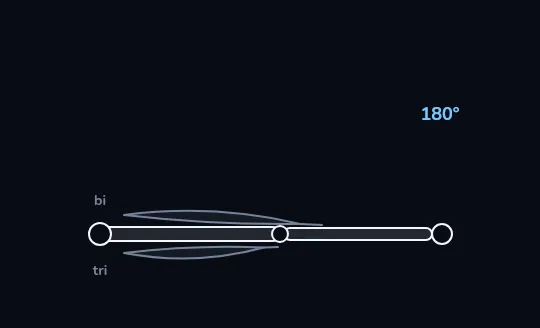
An arm held straight An arm seen from the side, held straight at 180°. The upper-arm bone runs to the elbow, the round hinge, and the forearm carries on from it. The biceps (bi) sits on the front and the triceps (tri) on the back, both thin and relaxed.
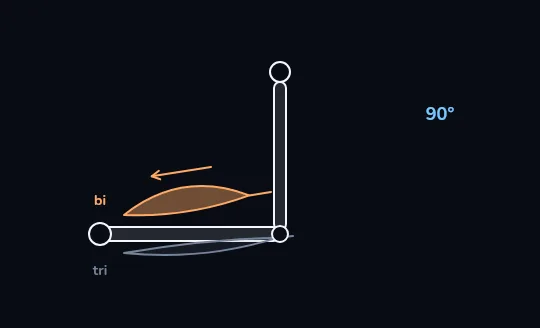
The biceps pulls, the elbow bends The biceps lights up, getting shorter and thicker, and the arrow shows it pulling toward the shoulder. The forearm swings up to 90°. Meanwhile the triceps relaxes and is stretched.
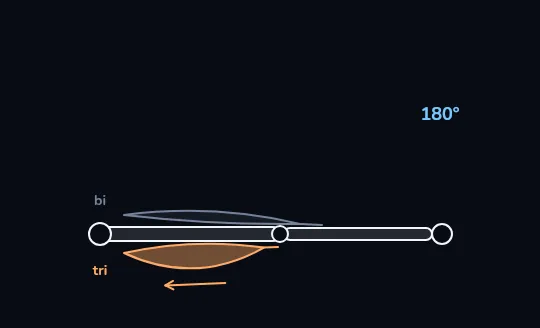
The triceps pulls it straight again To straighten the arm, the triceps lights up and pulls on the back of the elbow while the biceps relaxes; the forearm returns to 180°. A muscle can only pull, so it takes a pair to move a joint both ways.
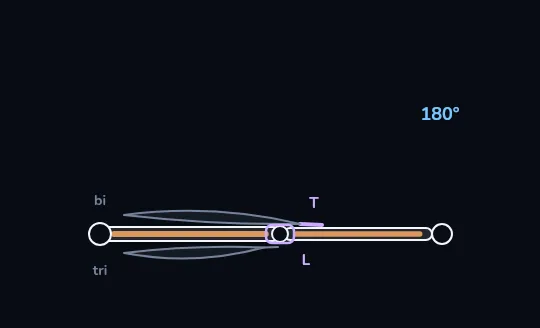
Tendon, ligament and marrow The same straight arm, with three things marked. T is a tendon, where the biceps is tied to the forearm bone; L is a ligament, a band across the elbow tying bone to bone. The orange line down the middle of each bone is the marrow, where blood cells are made.
Check yourself
Your biceps contracts. What happens at the elbow?
- It straightens, as the biceps pushes the forearm down
- It bends, as the forearm is pulled up
- Nothing, unless the triceps contracts at the same moment
- It locks so the arm can't move
Show the answer
It bends, as the forearm is pulled up
Right. The biceps shortens and pulls the forearm up, so the elbow bends, just like the jump from 180° to 90° in the frames.
Tendon or ligament?
Tendon
Joins muscle to bone. It passes the muscle's pull on to the bone.
Example: the Achilles tendon joins your calf muscle to your heel bone.
Ligament
Joins bone to bone at a joint. It keeps the joint stable and stops it moving too far.
Example: a sprained ankle is usually a stretched or torn ligament.
Check yourself
What connects a muscle to a bone?
- A ligament
- A tendon
- Cartilage
- Bone marrow
Show the answer
A tendon
Right. Tendons tie muscle to bone; ligaments tie bone to bone.
Check yourself
Sort each joint by how it moves
- Elbow
- Knee
- Shoulder
- Hip
Show the answer
Hinge: bends one way: Elbow, Knee
Ball and socket: many directions: Shoulder, Hip
Lesson recap
- An adult has about 206 bones; they're living tissue that is constantly rebuilt, and they heal.
- Bones support, protect, act as levers, make blood cells in the red marrow and store calcium.
- Joints are where bones meet: hinges like the elbow and knee bend one way; ball-and-socket joints like the shoulder and hip move in many directions.
- There are three kinds of muscle: skeletal, cardiac and smooth. A muscle can only pull, so muscles work in antagonistic pairs, like the biceps and triceps.
- Tendons join muscle to bone; ligaments join bone to bone.