
Digestion: from plate to cell
The trip food takes through the gut, what each stop does to it, and where the useful parts finally get into the blood.
SMALL ENOUGH TO CROSS
Digestion is breaking food down until it fits through
Food is made of big molecules that can't pass through the gut wall. Digestion breaks each kind into its small building blocks: carbohydrates into simple sugars like glucose, proteins into amino acids, and fats into fatty acids and glycerol. It happens in two ways at once. Mechanical digestion is physical: chewing and churning break food into smaller pieces. Chemical digestion uses enzymes, proteins that speed up the breaking of the molecules themselves.
A mouthful of bread is mostly starch, a long chain of glucose units. Chewing breaks the bread into crumbs; enzymes then cut the starch chain into sugars small enough to be absorbed.
Check yourself
Why does your body have to break a meal down before it can use it?
- Because big food molecules can't cross the gut wall into the blood; small ones like glucose and amino acids can
- Because the stomach can only hold small pieces
- Because food has no energy until it's broken down
- Because enzymes are only made when food is present
Show the answer
Because big food molecules can't cross the gut wall into the blood; small ones like glucose and amino acids can
Right. The gut wall only lets small molecules through. Breaking starch into sugars, protein into amino acids and fat into fatty acids is what lets the useful parts reach your blood.
Step through it
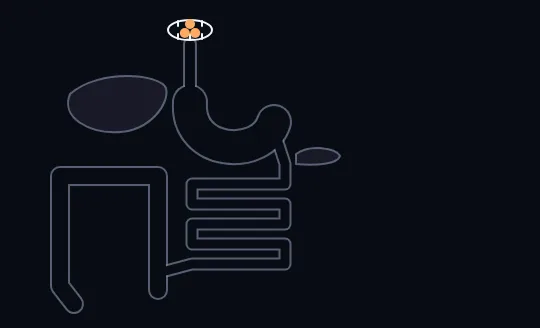
A meal at the mouth, chewed into pieces The whole digestive tract is drawn as one tube, still dim: the mouth at the top, a straight oesophagus, the stomach, the coiled small intestine and the large intestine as a square arch; the two side shapes are the liver and the pancreas. At the mouth, the teeth have split the food (orange) into small pieces, and saliva is already starting to break down starch.
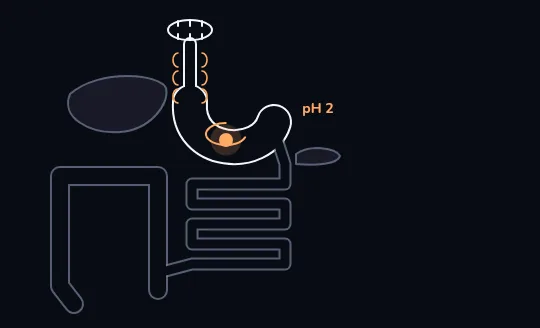
Down the oesophagus into an acid stomach The curved lines along the oesophagus are waves of muscle squeezing the food down, a movement called peristalsis. The stomach lights up and churns the food (the swirl) in strong acid, marked pH 2, while its enzymes start breaking down protein. A meal usually stays here for a few hours.
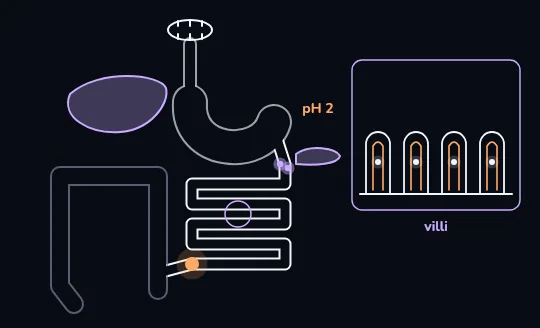
Small intestine: juices in, nutrients out The food, now a mush, moves into the coiled small intestine. The liver and the pancreas light up and their juices drip in: bile from the liver breaks fat into small droplets, and the pancreas adds enzymes for carbohydrate, protein and fat. The box zooms in on the gut wall: its finger-like folds are the villi, and the small white dots are nutrients crossing into the blood vessels (orange) inside each one.
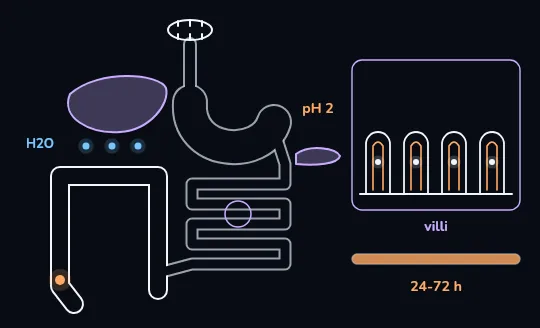
The large intestine takes back water What's left has moved through the large intestine and reached its end. The blue dots marked H2O are water being taken back into the body along the way, which is the large intestine's main job. The bar marked 24-72 h is the whole trip, from plate to exit: roughly one to three days, and it varies a lot between people and meals.
Check yourself
From the frames: where did the nutrients actually cross into the blood?
- In the mouth, as the food was chewed
- In the stomach, in the acid
- Through the villi of the small intestine
- In the large intestine, with the water
Show the answer
Through the villi of the small intestine
Right. The stomach starts the work, but almost all absorption happens in the small intestine, through the villi. The large intestine mostly takes back water and salts.
What each stop does
- Mouth: teeth chew, and an enzyme in saliva (amylase) starts breaking starch into sugars.
- Oesophagus: waves of muscle (peristalsis) push each mouthful down. It works even if you swallow upside down, because it doesn't rely on gravity.
- Stomach: churns food in strong acid (pH roughly 1.5 to 3.5) with an enzyme (pepsin) that starts on protein. A layer of mucus protects the stomach from its own acid.
- Small intestine: several metres long (roughly 3 to 7 m, depending on how it's measured). Most digestion and almost all absorption happen here.
- Large intestine: takes back water and salts. What's left leaves the body as faeces.
Villi
Millions of tiny finger-like folds lining the small intestine. Each one holds a network of capillaries, so digested sugars, amino acids and fats have only a very thin wall to cross. Together they give the small intestine a huge surface for absorbing, far larger than a smooth tube of the same length.
A towel dries you better than a sheet of plastic the same size because its loops give it far more surface. The villi do the same trick for absorbing food.
Bile is washing-up liquid for fat
Fat doesn't mix with the watery juices in your gut; it clumps together, like grease in a pan. Bile, made by the liver and stored in the gallbladder, works like washing-up liquid: it breaks the clumps into many tiny droplets. That gives the fat-digesting enzymes from the pancreas far more surface to work on. Where the analogy matters: bile is not an enzyme. It doesn't cut any molecule apart; it only spreads the fat out so the enzymes can.
Check yourself
What does bile actually do to the fat in a meal?
- It breaks the chemical bonds in fat, like an enzyme
- It breaks fat into small droplets so enzymes can reach more of it
- It carries fat straight into the blood
- It neutralises fat so it isn't absorbed
Show the answer
It breaks fat into small droplets so enzymes can reach more of it
Right. Bile emulsifies fat: it turns big clumps into tiny droplets. The actual chemical breaking is done by enzymes from the pancreas, which now have far more surface to work on.
AFTER THE GUT WALL
The liver checks it first, the bacteria get the rest
Sugars and amino acids absorbed in the small intestine don't go straight round the body. Their blood goes first to the liver, which stores some of the sugar, processes the rest and breaks down many harmful substances. Further down, the large intestine is home to trillions of gut bacteria. They break down some of the fibre you can't digest yourself and make some vitamins, such as vitamin K. Most of these microbes are harmless or helpful.
After a meal rich in bread or rice, the liver stores some of the extra glucose as glycogen. Between meals it releases it again, a job you'll see in lesson 11.
Check yourself
The strong acid in your stomach helps kill many of the germs that come in with food.
Show the answer
True
True. Besides starting on protein, stomach acid kills many microbes before they reach the intestine. It's one of the body's barriers, which you'll meet again in lesson 9.
Check yourself
Match each part of the gut to what mainly happens there
Show the answer
- Mouth → Starch starts to break down
- Stomach → Protein starts to break down in acid
- Small intestine → Most nutrients are absorbed
- Large intestine → Water is taken back
Lesson recap
- Digestion breaks big food molecules into small ones: carbohydrates into sugars, proteins into amino acids, fats into fatty acids and glycerol.
- It's both mechanical (chewing, churning) and chemical (enzymes).
- The stomach churns food in strong acid and starts on protein; the acid also kills many germs.
- Most digestion and almost all absorption happen in the small intestine, through millions of villi. Bile from the liver breaks fat into droplets; the pancreas supplies the enzymes.
- The large intestine takes back water. The whole trip takes roughly one to three days.