
Running for the bus: how it all works together
One short sprint followed through every system in the course, from the first signal in your brain to getting your breath back, and the habits that keep the team strong.
The first few seconds
- The brain decides
Your eyes spot the bus; the frontal lobe decides to run (lesson 10).
- Motor nerves fire
Signals race down the spinal cord and out along motor nerves to your legs, in a fraction of a second.
- Muscles pull in pairs
Leg muscles contract and relax in antagonistic pairs (lesson 3), burning through ATP fast (lesson 1).
- Adrenaline joins in
Within seconds your adrenal glands release adrenaline (lesson 11): the heart speeds up, and blood is sent to the muscles and away from the gut, so digestion pauses.
Check yourself
You decide to run. What gets your legs moving within a fraction of a second?
- Adrenaline reaching the leg muscles through the blood
- Signals from the brain along the spinal cord and motor nerves
- Extra glucose released by the liver
- Faster breathing bringing in more oxygen
Show the answer
Signals from the brain along the spinal cord and motor nerves
Right. Nerves are the fast channel: the command goes from brain to spinal cord to motor nerves to muscles in a split second. Adrenaline, glucose and faster breathing follow over the next seconds and minutes.
Step through it
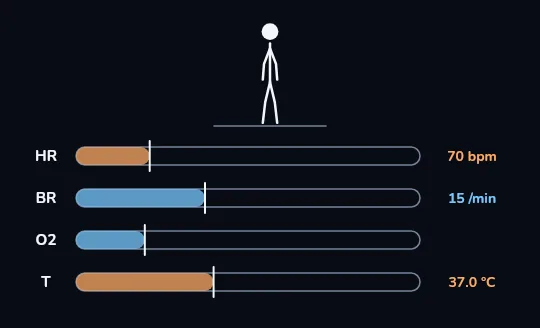
At rest, waiting at the stop A dashboard of four bars. HR is heart rate, about 70 beats a minute; BR is breathing, about 15 breaths a minute; O2 is how much oxygen is flowing to the muscles, low for now; T is core temperature, about 37.0 °C. The figure is standing still, and the white tick on each bar marks its resting level.
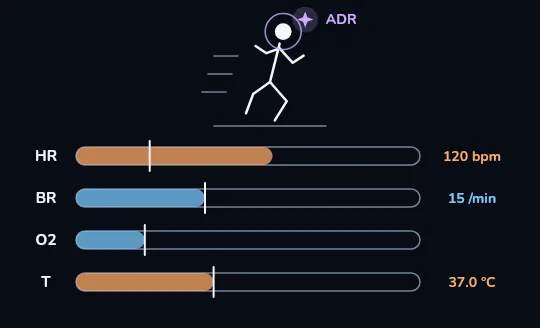
The command, then adrenaline The figure starts running. The spark at its head is the brain's command, and the lilac mark ADR is adrenaline being released. Within seconds the heart-rate bar jumps from 70 to 120 beats a minute. Breathing and temperature haven't changed yet: the heart moves first.
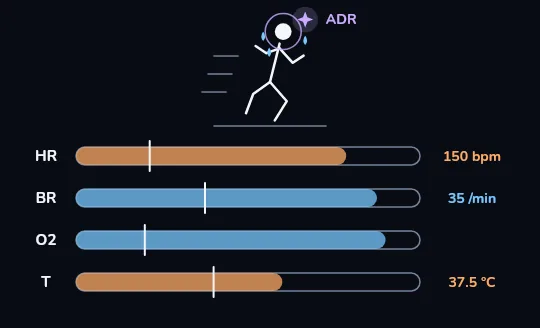
Full sprint: more air, more blood, more heat Mid-sprint, everything is up. The heart is at 150 beats a minute and breathing at 35 a minute, driven by the extra CO2 the muscles make. The O2 bar is nearly full: far more oxygen is reaching the muscles. Working muscles also make heat, so temperature nudges up to 37.5 °C, and the small drops by the head are sweat starting to cool you.
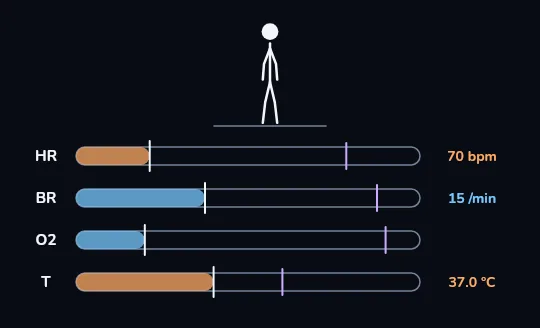
On the bus: back to the set points You made it. The figure stands still and every bar slides back to its resting level: 70 beats and 15 breaths a minute, low oxygen flow, 37.0 °C. The lilac ticks mark how high each one went during the run. That return to the set points, over a few minutes, is homeostasis at work.
Check yourself
In the sprint frames, breathing climbed from 15 to 35 a minute. What mainly drives that?
- Low oxygen in the lungs, sensed by the heart
- The legs telling the lungs directly to work harder
- Rising carbon dioxide from working muscles, sensed by the brainstem
- Adrenaline alone, with nothing else involved
Show the answer
Rising carbon dioxide from working muscles, sensed by the brainstem
Right. Working muscles make more CO2; the brainstem senses it rising in the blood and drives faster, deeper breathing, just like the urge to breathe after holding your breath (lesson 6).
ONE CHAIN, ALL AT ONCE
The oxygen delivery chain speeds up together
A running muscle needs oxygen and glucose faster, and has more CO2 to get rid of. So the whole chain speeds up at once: the lungs breathe faster and deeper, the heart pumps faster and pushes more blood with each beat, arteries carry it to the legs, capillaries hand oxygen to the muscle cells, and their mitochondria turn it into ATP. At the same time the liver releases stored glucose for fuel. If any one link lagged, the others couldn't make up for it.
At rest your heart moves about 5 litres of blood a minute (lesson 5). In hard exercise that can rise several times over, and most of the extra goes to the working muscles.
Check yourself
Follow one oxygen molecule from the air to a leg muscle. Which order is right?
- Air → heart → alveoli → capillary → artery → mitochondria
- Air → alveoli → blood → heart → artery → capillary → mitochondria
- Air → artery → alveoli → heart → capillary → mitochondria
- Air → alveoli → vein → capillary → heart → mitochondria
Show the answer
Air → alveoli → blood → heart → artery → capillary → mitochondria
Right. In through the airways to the alveoli, across into the blood, back to the heart, out along an artery, through a capillary into the muscle cell, and finally used in its mitochondria.
KEEPING COOL
Getting rid of the heat
Muscles turn only part of their fuel into movement; much of the rest comes out as heat. To hold your core temperature near 37 °C, two things happen. Vessels in your skin widen, so more warm blood flows near the surface and loses heat to the air: that's the flushed face. And you sweat: as sweat evaporates from your skin, it carries heat away. The water you lose in sweat has a knock-on effect later: your kidneys hold on to more water for a while, and your urine is darker (lesson 8).
On a humid day sweat evaporates more slowly, so it cools you less well, which is one reason the same run feels harder in muggy weather.
Check yourself
By the time you reach the bus, your face is red and you're sweating. Why?
- To release the extra heat from your muscles and keep your core near 37 °C
- Because your heart is pumping blood out through your skin
- Because adrenaline turns your skin red to scare others off
- Because your kidneys are getting rid of extra water
Show the answer
To release the extra heat from your muscles and keep your core near 37 °C
Right. Working muscles make heat. Widened skin vessels let warm blood lose heat at the surface, and evaporating sweat carries more away, keeping your core close to 37 °C.
Homeostasis
Keeping the conditions inside the body steady, around set points such as a core temperature near 37 °C, blood sugar near 5 mmol/L and a resting heart rate around 60 to 100, while the outside, or what you're doing, keeps changing. It works mostly by negative feedback (lesson 11), and it's the goal every system in this course serves.
In the few minutes after the sprint, as the extra CO2 is cleared, your breathing and heart rate settle back toward 15 and 70. Nothing had to tell them to: that's the feedback loops pulling everything home.
Check yourself
Which of these best describes homeostasis in the minutes after the run?
- Your heart rate stays at 150 until you next sleep
- Your body temperature keeps rising until you drink water
- Your muscles stop using ATP completely
- Your heart and breathing rates return to their resting set points
Show the answer
Your heart and breathing rates return to their resting set points
Right. Homeostasis is the pull back to the set points: as the extra CO2 is cleared and adrenaline fades, heart rate and breathing settle back toward about 70 and 15.
Keeping the team strong: what the WHO advises adults
- At least 150 to 300 minutes of moderate activity a week, like brisk walking, or 75 to 150 minutes of vigorous activity, like running.
- Muscle-strengthening activity on 2 or more days a week.
- Don't smoke: it damages the alveoli (lesson 6) and the blood vessels.
- Enough sleep, and routine check-ups such as having your blood pressure measured, which often has no symptoms when it's high (lesson 5).
- These are general guidelines for healthy adults, not a personal plan. A doctor can say what suits you.
Check yourself
Match each part of the body to its job during the sprint
Show the answer
- Motor nerves → Carry the command to the legs
- Heart → Pumps faster to send more blood
- Lungs → Take in more O2 and clear the CO2
- Skin → Sweats to shed heat
- Liver → Releases stored glucose for fuel
Lesson recap
- A sprint starts with nerves: brain to spinal cord to motor nerves to leg muscles, in a fraction of a second.
- Adrenaline follows within seconds: heart rate climbs from about 70 toward 120 to 150, and blood is sent to the muscles.
- Rising CO2, sensed by the brainstem, drives breathing from about 15 toward 30 to 40 a minute, and the whole oxygen chain speeds up together.
- Muscles make heat; widened skin vessels and sweat keep your core near 37 °C, and the kidneys hold on to water afterwards.
- On the bus, everything returns to its set points: homeostasis. No system works alone; each lesson's organ is a link in the same chain.