
Nerves and the brain
How a nerve cell carries a signal, how signals cross the gap to the next cell, what a reflex is, and which parts of the brain do what.
THE MESSENGER CELL
Neurons: electric along the wire, chemical across the gap
Nerve cells are called neurons. Each has dendrites, short branches that receive signals, a cell body that processes them, and a long axon that sends the signal on. Your brain alone has roughly 86 billion neurons. Along the axon the signal travels as a tiny electrical pulse. But neurons don't quite touch: between one and the next there's a tiny gap, the synapse. There the signal turns chemical: the first neuron releases neurotransmitters, chemical messengers that drift across the gap and trigger the next cell.
Fast nerve fibres carry signals at up to roughly 100 metres a second or more; slow ones at about 1 metre a second. That's why, when you stub a toe, you feel the sharp knock first and the dull ache a moment later.
Check yourself
A signal reaches the end of one neuron. How does it get across the synapse to the next one?
- It jumps across as a spark of electricity
- The first neuron releases chemical messengers that cross the gap
- The two neurons touch and the signal flows straight through
- It travels through the blood to the next neuron
Show the answer
The first neuron releases chemical messengers that cross the gap
Right. At the synapse the signal becomes chemical: neurotransmitters are released, cross the tiny gap and trigger the next cell, which turns it back into an electrical pulse.
Step through it
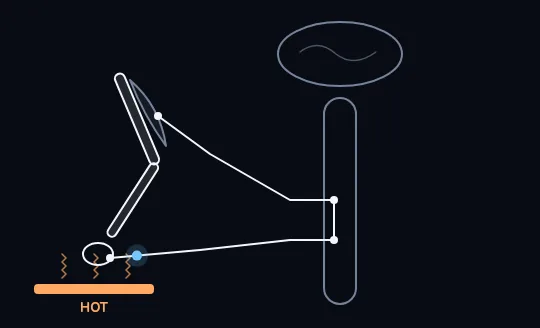
A fingertip touches the hot plate Your hand rests on a plate marked HOT, with heat rising from it. A sensor in the fingertip fires the moment it touches, and the bright blue dot is that signal starting along the sensory nerve toward the spinal cord, the tall column in the middle. The brain at the top and the arm muscle are still dim: nothing has reached them yet.
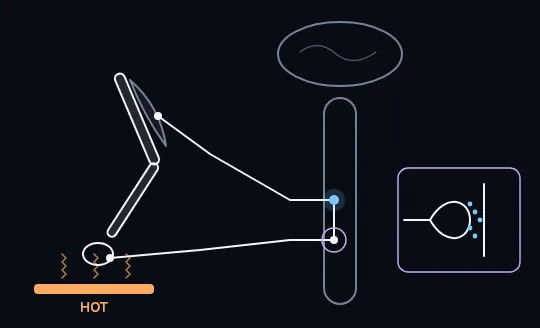
The signal reaches the spinal cord The signal has reached the spinal cord. The box on the right zooms in on a synapse there: the end of one neuron releases tiny particles, the chemical messengers, which cross the gap to the next neuron. The signal is handed straight to a second nerve without going up to the brain first.
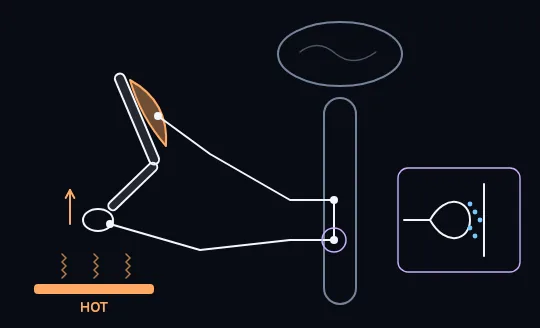
The spinal cord sends the command back A new signal runs out of the spinal cord along the motor nerve to the arm muscle, which glows orange as it contracts. The arrow shows the result: the hand lifts off the hot plate. The whole trip, fingertip to spinal cord to muscle, takes only a fraction of a second.
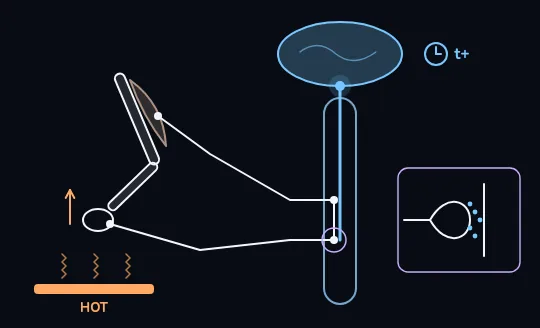
Only now does the brain feel it Meanwhile the signal also climbs up the spinal cord to the brain, which lights up. Only now do you feel the heat as pain. The clock marked t+ is the point: that happens after your hand has already moved. The reflex protected you before you knew there was anything to be protected from.
Check yourself
Which order matches the reflex you just watched?
- Brain → spinal cord → motor nerve → muscle → sensor in the skin
- Sensor in the skin → brain → motor nerve → muscle
- Sensor in the skin → sensory nerve → spinal cord → motor nerve → muscle
- Muscle → motor nerve → spinal cord → sensory nerve → sensor in the skin
Show the answer
Sensor in the skin → sensory nerve → spinal cord → motor nerve → muscle
Right. That's the reflex arc: in through the sensory nerve, turned round in the spinal cord, out through the motor nerve to the muscle. The brain gets the news on a separate branch, afterwards.
How the network is laid out
- Central nervous system: the brain and the spinal cord, where signals are sorted and decisions made.
- Peripheral nervous system: all the nerves that branch out from there to the rest of the body.
- Sensory nerves carry information in, from skin, eyes, ears and organs. Motor nerves carry commands out, to muscles and glands.
- A reflex is a built-in shortcut through the spinal cord or brainstem: automatic, very fast and protective. Blinking when something flies at your eye is another one.
Check yourself
In a reflex like pulling your hand off a hot plate, your hand moves only after your brain has registered the pain.
Show the answer
False
False. The spinal cord sends the command to the muscle directly, so the hand is already moving by the time the signal reaches the brain and you feel pain. Skipping the brain is what makes a reflex so fast.
WHO DOES WHAT UP THERE
The main parts of the brain
The large wrinkled cerebrum has two halves, each with four lobes: the frontal lobe (planning, decisions, starting movement), the parietal lobe (touch and where your body is), the temporal lobe (hearing, language, memory) and the occipital lobe at the back (vision). Tucked under the back is the cerebellum, which handles balance and smooth coordination. The brainstem, joining the brain to the spinal cord, runs automatic life support: breathing and heart rate. It's the part that senses rising CO2 and makes you breathe (lesson 6).
Running for the bus: your occipital lobe spots the bus, your frontal lobe decides to go for it, your cerebellum keeps you from tripping on the kerb, and your brainstem speeds up your breathing, all at the same time.
Check yourself
We only use about 10% of our brain.
Show the answer
False
False, though it's a popular myth. Brain scans show activity throughout the brain; different areas are busier at different times, but there's no large unused 90%. Damage to almost any area has some effect.
Check yourself
Match each part of the brain to its main job
Show the answer
- Frontal lobe → Planning and decisions
- Occipital lobe → Vision
- Cerebellum → Balance and coordination
- Brainstem → Breathing and heart rate
Lesson recap
- Neurons carry signals: electrical along the axon, chemical across the synapse, where neurotransmitters cross the gap.
- The brain and spinal cord form the central nervous system; sensory nerves bring information in and motor nerves carry commands out.
- In a reflex, the spinal cord sends the command straight back to the muscle, so your hand moves before your brain feels the pain.
- The cerebrum plans, senses and remembers; the cerebellum handles balance; the brainstem runs breathing and heart rate.
- The brain is about 2% of body weight but uses about 20% of its resting energy, and you use all of it, not 10%.