
Leading lines and framing
Roads, rails, fences and shorelines can walk the viewer's eye straight to your subject, and a doorway or branch can frame it. Learn to find them, change your height and angle, and clean the edges of the frame.
LEADING LINES
Lines pull the eye along them
Roads, rails, paths, fences, rivers, shorelines, rows of trees and stairs all draw the eye along their length. They work best when they lead towards the subject, often starting at a bottom corner of the frame. Parallel lines running away from you appear to converge towards one spot, the vanishing point, and a subject near that spot gets all the attention. Diagonal lines feel lively, horizontal lines calm, and an S-curve, like a winding path or river, leads the eye gently. Avoid lines that run out of the frame or into an empty corner: the eye follows them there and leaves.
A railway line shot from between the rails: the two rails start wide at the bottom corners and meet near the middle. Put a person walking on the track near where they meet, and nobody looks anywhere else.
Check yourself
Reza is photographing his sister on a pier. The wooden boards form strong lines. When will those lines help the picture most?
- When they run off the side of the frame, away from her
- When they start near the bottom of the frame and lead towards her
- When they are perfectly horizontal across the middle
- Lines never matter as long as she's in focus
Show the answer
When they start near the bottom of the frame and lead towards her
Right. Lines starting near the bottom and running towards her pick the eye up at the edge of the picture and deliver it to her.
FRAMING
A frame inside the frame
Shoot through something: a doorway, a window, an arch, overhanging branches, the gap between two people's shoulders. The inner frame adds depth, because it's clearly nearer than the subject, it hides clutter at the edges, and it points at the subject from all sides at once. The frame can be dark or slightly blurred; it doesn't have to be sharp to work.
Mina's friend stands in a sunny courtyard. From the dim hallway, Mina frames her in the dark doorway: the walls go black, the clutter beside the courtyard disappears, and all that's left is her friend in a bright rectangle.
Check yourself
Match each kind of line to the feeling it usually gives
Show the answer
- Diagonal line → Energy and movement
- Horizontal line → Calm and stillness
- S-curve → A gentle, winding lead into the picture
- Parallel lines meeting far away → Everything points at one spot
Step through it

A small subject in a frame full of distractions A friend stands small near the top of a wide, empty frame, while bright coloured spots are scattered around the edges. Nothing tells the eye where to go, so it wanders to the distractions first.
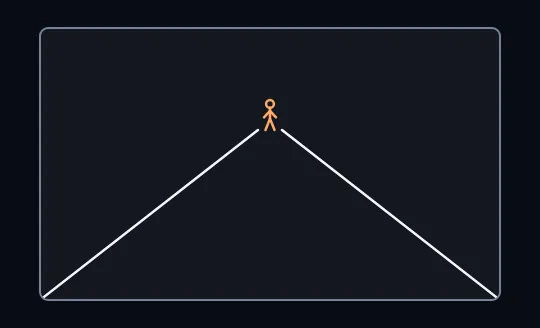
Two road lines lead from the bottom corners to her The two edges of a road now start at the bottom corners and meet right at the friend's feet, and the scattered spots are gone. The lines pick the eye up at the bottom of the picture and lead it straight to her.
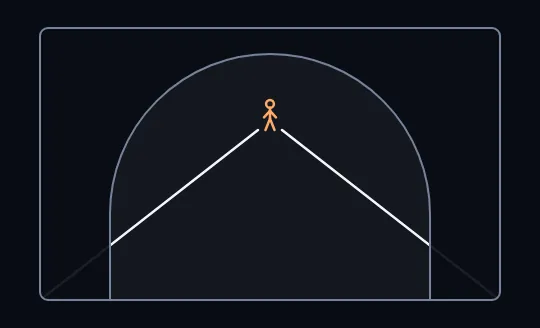
A doorway arch frames the scene A dark doorway arch now wraps around the scene, with the friend standing inside its opening and the road still leading to her. The frame adds depth, covers the edges, and points at her a second time.
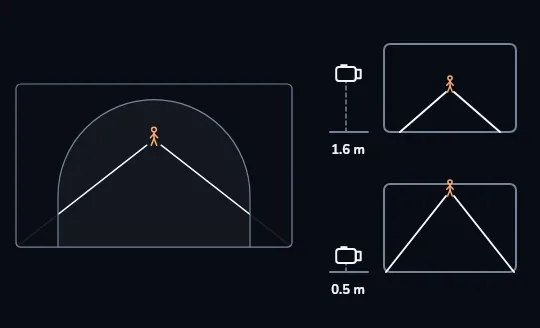
Standing at 1.6 m or crouching at 0.5 m The framed picture moves aside for a side view of two camera heights: standing at 1.6 m and crouched at 0.5 m. In the low camera's thumbnail the road lines start wider, run longer and climb more steeply to the friend, so they lead harder. Changing your height changes the picture.
Check yourself
In the last frame, what changed in the picture when the camera went down from 1.6 m to 0.5 m?
- The friend disappeared from the frame
- The road lines got longer and steeper, so they lead more strongly to her
- The road lines became horizontal
- Nothing, only the camera moved
Show the answer
The road lines got longer and steeper, so they lead more strongly to her
Right. Close to the ground, the road fills more of the frame, so its edges start wider at the bottom and climb steeply to her. Same road, stronger lines.
Change your height
Standing, about 1.6 m
Where almost every snapshot is taken from, so it looks ordinary. You look down on children and pets and see the tops of their heads, and paths look short and flat.
Low or high on purpose
Crouch to a child's or a dog's eye level and the picture feels like their world. Get low to stretch a path's lines. Shoot straight down from above for food and flat-lays on a table. Any height other than standing already stands out.
Clean the frame before you press
- Look behind the head
Is a pole, a tree or a lamp post growing out of it? A bright window right behind it?
- Run your eye round the four edges
Half-cut people, a bright spot, a car bumper poking in. Bright things at the edge pull the eye out.
- Check the horizon
A tilted sea or street looks like a mistake. Use the level line if your phone has one.
- Take one step
A step sideways, forward or down fixes most of these. Simplify: fewer things, one clear subject. Empty sky or a plain wall around a small subject can make it stronger.
Check yourself
Sara photographs her friend in the street, and in the picture a lamp post seems to be growing straight out of her friend's head. What's the simplest fix?
- Zoom in digitally until the post is out of the frame
- Take a step or two sideways so the post is no longer behind her head
- Switch on the flash
- Edit the post out later
Show the answer
Take a step or two sideways so the post is no longer behind her head
Right. A step sideways changes what lines up behind her, and the post slides out from behind her head. It takes two seconds and costs nothing.
The tree-lined path, done properly
- Crouch so the path fills the bottom of the frame and its edges start at the bottom corners.
- Put your friend near where the path's lines meet, on or near a third.
- Let a low branch across the top act as a frame.
- Scan the edges and behind her head, then take a step if something's in the way.
Check yourself
When Nima photographs his two-year-old nephew, standing at his normal height gives the most natural, engaging picture.
Show the answer
False
False. From standing height you look down on the top of a small child's head. Crouch to his eye level and the picture feels natural and engaging, as if you're in his world rather than looming over it.
Lesson recap
- Roads, rails, fences, rivers and stairs lead the eye along them; make them lead towards the subject, often from a bottom corner.
- Parallel lines converge towards a vanishing point, and a subject near it gets all the attention.
- A doorway, window, arch or branches can frame the subject, adding depth and hiding clutter.
- Change your height: crouch for children, pets and stronger lines, shoot from above for food.
- Before pressing, scan the edges and behind the head, and take a step to fix what you find.