
Natural light and golden hour
The same place looks completely different at noon, at golden hour and just after sunset. Learn hard and soft light, where the light is coming from, and how to use shade, clouds and windows.
HARD AND SOFT
It's the size of the source that matters
Hard light comes from a source that is small compared with the subject, or far away for its size: the direct sun on a clear day, a bare bulb, a phone's flash. It gives dark shadows with sharp edges and high contrast. Soft light comes from a source that is large compared with the subject: an overcast sky, a big window, open shade. Light arrives from many directions at once, so shadows are gentle with soft edges. The sun is huge, but so far away that in the sky it's a small dot, which is why it's hard.
Hold your hand over a table in direct sun: a crisp, black shadow. Do the same next to a big north-facing window: a faint, fuzzy one.
Check yourself
Which of these makes light soft?
- A source that is large compared with the subject, like an overcast sky or a big window
- A source that is very bright
- A source that is very small and close
- Any light that comes from the front
Show the answer
A source that is large compared with the subject, like an overcast sky or a big window
Right. A large source sends light from many directions at once, so shadows get soft edges. Brightness and direction don't change that.
MIDDAY
The midday sun is high and hard
Around noon the sun is high overhead and it's hard light: dark shadows under the eyes, nose and chin, squinting faces, and a sky so much brighter than the shade that the sensor can't hold both at once. You have options. Move the person into open shade, shade with open sky in front of them, such as under a tree at the edge of a park or beside a building. Wait for a cloud to cover the sun. Or shoot something that suits hard light: bold graphic shadows, architecture, bright colours.
Reza's friends squint on a sunny square at noon. He moves them three steps into the shadow of a building, facing the open square: the squinting stops and the shadows under their eyes disappear.
Check yourself
Midday on a clear day is the best time for portraits, because that's when there's the most light.
Show the answer
False
False. There's plenty of light, but it's high and hard: dark shadows under the eyes and nose, and people squint. More light isn't better light. Open shade, a cloud or a later hour will flatter faces far more.
Step through it
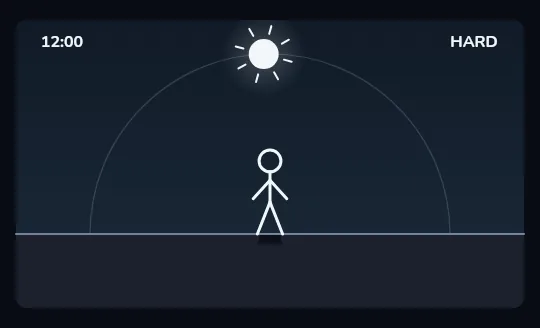
12:00: the sun overhead, hard light At 12:00 the sun sits at the top of its arc, straight above the figure, which casts only a short dark shadow at its feet. Light from that high makes small, hard shadows under the eyes and nose.
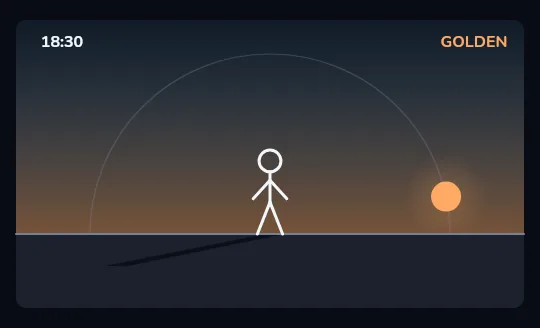
18:30: low, warm golden light At 18:30 the sun has dropped low on the right, only about 10 degrees above the horizon, and the sky has warmed to orange. The figure's shadow now stretches far to the left. In the last hour before sunset the low sun is warm and soft and casts long shadows.
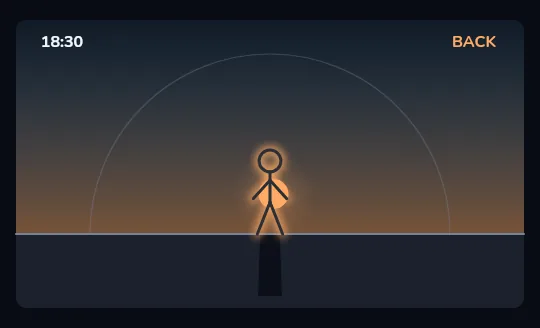
18:30: the sun behind the subject Still 18:30 and the sun is just as low, but now it sits right behind the figure, and the shadow falls towards the camera. The outline glows orange while the body and face turn dark. With backlight you choose: expose for the face, or keep it a silhouette.
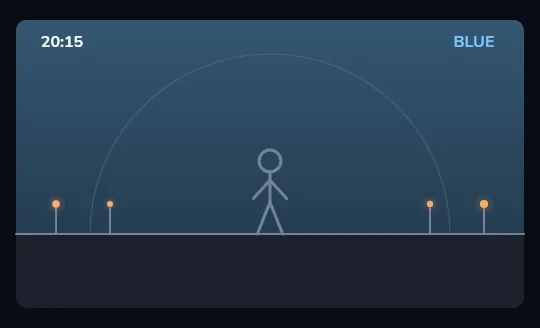
20:15: blue hour At 20:15 the sun has set, the sky has turned deep blue and the street lamps glow orange along the ground. The figure is now dim. This is blue hour: beautiful for city lights, but with far less light to work with.
Check yourself
Mina wants to photograph the city lights against a deep blue sky, like the last frame. When should she go?
- At noon, when the sky is brightest
- In the hour before sunset
- In the short time just after sunset, roughly 20 to 40 minutes, once the sun is below the horizon
- In the middle of the night
Show the answer
In the short time just after sunset, roughly 20 to 40 minutes, once the sun is below the horizon
Right. Blue hour is the short stretch just after sunset (and before sunrise) when the sun is below the horizon and the sky is still deep blue. It doesn't last long, so be ready.
Golden hour
Roughly the first hour after sunrise and the last hour before sunset, when the sun is low. The light is warm, soft and comes from the side, casting long shadows that flatter faces and show texture. How long it lasts depends on where you are and the season: longer far from the equator and in winter, shorter near the equator. Weather and photography apps show the times.
In summer, a park bench that looks flat and harsh at 13:00 can glow at around 18:30, with the low sun raking across the grass.
Where is the light coming from?
- Front light (sun behind you): flat and easy, few shadows, not much shape.
- Side light: shows texture and the shape of a face or a wall.
- Backlight (sun behind the subject): a glowing rim around hair and shoulders, or a silhouette.
- With backlight, tap the face to expose for it or add +1 EV, and the sky gets brighter; expose for the sky instead for a silhouette.
Check yourself
Sara photographs Nima with the sunset right behind him, and he comes out as a black shape against a lovely sky. She wants to see his face. What should she do?
- Lower the exposure to protect the sky
- Tap on his face so the phone exposes for it, or add about +1 to +2 EV, accepting a brighter sky
- Move further away
- Switch to the 0.5x lens
Show the answer
Tap on his face so the phone exposes for it, or add about +1 to +2 EV, accepting a brighter sky
Right. The camera exposed for the bright sky, so his face went black. Exposing for his face brightens him, and the sky gets brighter too. That's the trade.
Check yourself
Reza is looking for light for a portrait. Sort each source: hard or soft?
- Direct noon sun on a clear day
- A thick grey overcast sky
- A big window with no direct sun
- A bare bulb on the other side of the room
- Open shade beside a building
- The phone's own flash
Show the answer
Hard: Direct noon sun on a clear day, A bare bulb on the other side of the room, The phone's own flash
Soft: A thick grey overcast sky, A big window with no direct sun, Open shade beside a building
Lesson recap
- Hard light comes from a small or distant source, soft light from a source that's large compared with the subject.
- Midday sun is high and hard; use open shade, wait for a cloud, or shoot subjects that suit it.
- Golden hour, roughly the hour after sunrise and before sunset, gives warm, soft light and long shadows.
- Backlight gives a glowing rim; expose for the face or keep a silhouette.
- Blue hour, roughly 20 to 40 minutes after sunset, is deep blue and beautiful but has far less light.